 Jayk1@gmail.com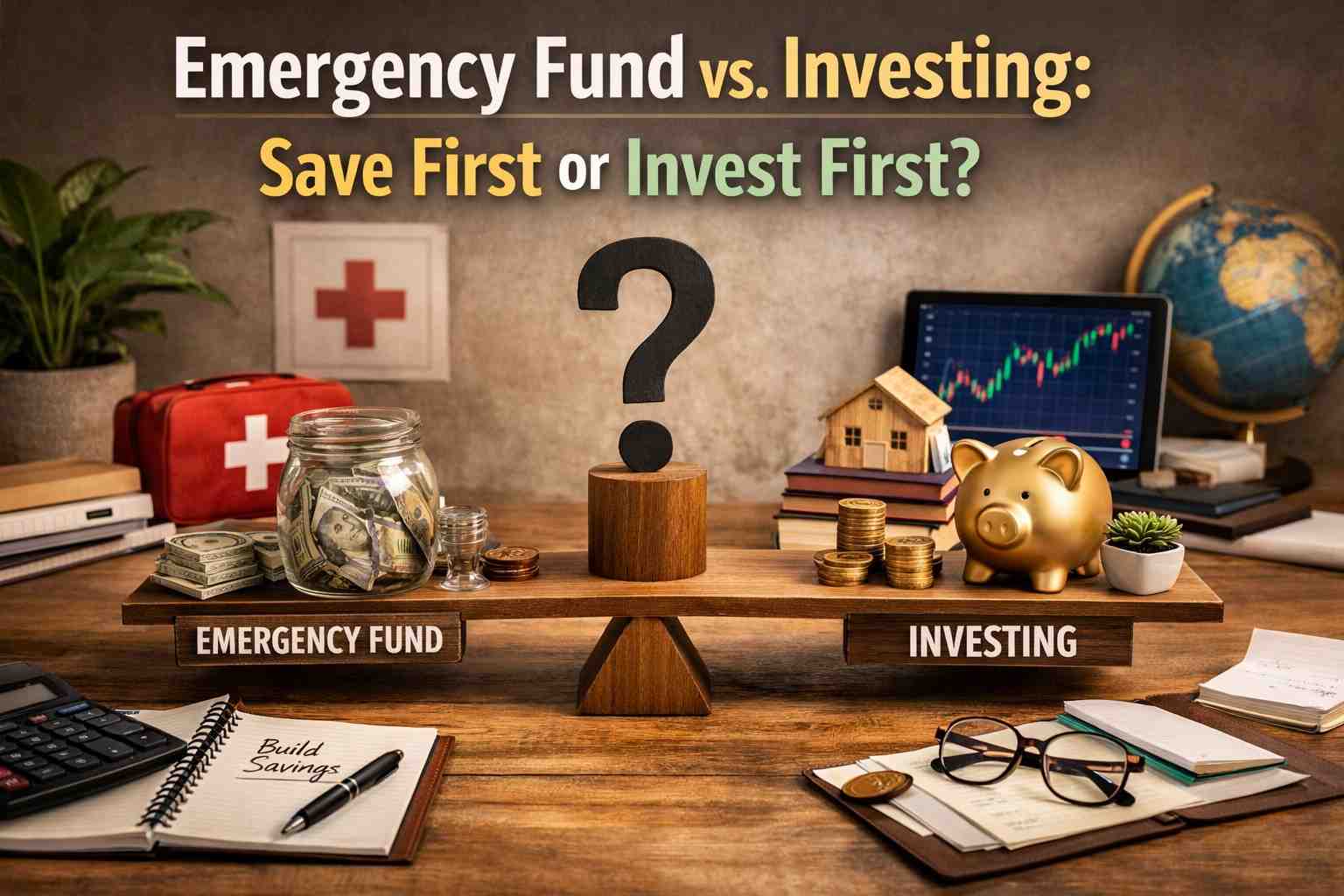
Introduction: Emergency Fund vs Investing
This question comes up constantly among people who are just starting to get serious about their finances. And honestly, it’s one of the better debates to have — because it means you’re thinking ahead, not just spending everything that comes in.
The emergency fund vs investing conversation isn’t really about which one is more important in an abstract sense. Both matter. The real question is: which one should you focus on first, given where you are right now?
The answer isn’t the same for everyone. But there is a logical sequence that makes sense for most people — and once you understand the reasoning behind it, the decision becomes a lot clearer.
Why This Decision Feels Confusing in the First Place
Part of what makes the emergency fund vs investing question tricky is that both sides have genuinely compelling arguments.
The investing side says: the stock market grows over time, and every month you delay is compounding growth you’ll never get back. Time in the market matters. Starting early matters.
The emergency fund side says: without a financial cushion, one bad event can derail everything — and you might end up pulling money out of investments at exactly the wrong time.
Both arguments are correct. That’s why people get stuck.
The confusion usually comes from treating this as an either/or choice. It’s not, not entirely. But there is a priority order that makes sense, and most people benefit from understanding it clearly before deciding anything.
What an Emergency Fund Actually Does for You
Before diving into the emergency fund vs investing comparison, it helps to be specific about what an emergency fund is actually doing in your financial life.
It’s not an investment. It’s not supposed to grow dramatically. Its job is to sit there, stay stable, and be available when something genuinely unexpected happens — job loss, a medical expense, a critical car repair, a sudden housing need.
Think of it like the spare tire in your car. You’re not driving on it every day. You hope you never need it. But if you get a flat at 10pm on a highway, you’re deeply grateful it’s there.
Without an emergency fund, any unexpected expense forces a choice between bad options: go into debt, withdraw from investments at a potentially poor time, or simply not handle the problem. None of those are good.
So the emergency fund’s value isn’t measured in percentage returns. It’s measured in the crises it prevents.
What Investing Actually Does for You
Investing, on the other hand, is about growing your wealth over time by putting money into assets — stocks, index funds, retirement accounts, real estate — that tend to increase in value.
The core advantage of investing is compounding. When your investments grow, that growth itself generates more growth. A small amount invested early can become a significantly larger amount over decades.
This is why the emergency fund vs investing debate gets heated. Every year you delay investing is a year of potential compounding you’re giving up. That’s a real cost.
But here’s the thing that often gets left out of that argument: investing without financial stability underneath you is genuinely risky. Not in a theoretical way — in a very practical, real-life way.
The Risk of Investing Without an Emergency Fund
Imagine this. You put $3,000 into an index fund instead of building an emergency fund. Six months later, your car breaks down and needs a $1,800 repair you can’t ignore.
You have two options. You could go into credit card debt at a high interest rate. Or you could sell your investments to cover the repair.
If the market is down at that moment — which it sometimes is, unpredictably — you’re selling at a loss. You lock in that loss. The whole point of long-term investing is that you don’t sell during downturns. But without an emergency fund, life forces your hand.
This is one of the central arguments in the emergency fund vs investing discussion: an emergency fund protects your investments. It gives you the staying power to leave your money in the market when things get rough, because your day-to-day stability doesn’t depend on it.
The Standard Recommendation and Why It Makes Sense
Most personal finance guidance suggests this sequence:
- Build a small starter emergency fund first ($500–$1,000)
- Pay off any high-interest debt
- Build a full emergency fund (3–6 months of essential expenses)
- Then begin investing more seriously
The reason for the starter fund before tackling debt is simple: if you aggressively pay down debt with every spare dollar but have zero savings, the first unexpected expense lands right back on your credit card. You haven’t actually made progress — you’ve just moved money in a circle.
The starter fund breaks that cycle. It gives you a small buffer so that minor emergencies don’t immediately become new debt.
After that, high-interest debt typically takes priority because paying 20–25% interest on a credit card is worse than most investments can reliably beat. Clearing that debt is essentially a guaranteed return.
Then the full emergency fund. Then more aggressive investing.
In the emergency fund vs investing comparison, this sequence puts emergency savings first — but not indefinitely. It’s about building the foundation before adding the structure on top.
When It’s Reasonable to Do Both at the Same Time
The standard sequence works well for most people. But there are situations where splitting your savings between an emergency fund and investments makes sense simultaneously.
When You Have Employer-Matched Retirement Contributions
If your employer matches your retirement contributions up to a certain percentage, not contributing at least enough to get that full match is leaving compensation on the table. That match is an immediate 50–100% return on your contribution, which almost nothing else can compete with.
In this specific case, contributing just enough to get the full employer match — while also building your emergency fund — is usually the smarter move, even if it slows your savings pace a little.
When You Already Have Some Emergency Savings but Not the Full Amount
If you have two months of expenses saved and you’re financially stable, you’re not completely unprotected. At that point, splitting your monthly savings between topping up the emergency fund and starting some modest investing can be reasonable.
This is different from having zero savings. Having some cushion already changes the risk profile of the emergency fund vs investing decision.
When Your Income Is Very Stable and Predictable
Someone with a highly stable, government or long-term contract job, no dependents, low expenses, and a solid safety net through family or other means faces less risk from market volatility than someone with irregular income and high fixed expenses.
Stability of income matters when making the emergency fund vs investing calculation. The more unpredictable your income, the more important the emergency fund becomes as your first priority.
The Psychological Side of This Decision
Here’s something that doesn’t get discussed enough in the emergency fund vs investing debate: the psychological dimension.
Investing when you have no financial cushion creates anxiety. Every market dip feels like a crisis. Every unexpected bill makes you want to sell. Emotional investing is almost always worse investing.
An emergency fund makes you a calmer investor. Knowing your day-to-day life is protected from unexpected expenses means you can actually leave investments alone during downturns — which is precisely when most people make costly mistakes.
On the flip side, having a large emergency fund while completely avoiding investing can also create its own anxiety — the feeling that you’re falling behind, watching others grow their wealth while your savings sit in a low-yield account.
Both feelings are real. Acknowledging them matters. The goal is a structure that keeps you genuinely secure without making you feel paralyzed.
How Much Should Your Emergency Fund Be Before You Start Investing Seriously?
For most people, having somewhere between one and three months of essential expenses saved is a reasonable point to start directing money toward investments as well.
You don’t necessarily need the full six months before touching investments. That’s the ideal target, but waiting until you’ve fully funded six months before investing a single dollar can mean delaying investing for a year or more — especially on a modest income.
A practical middle path: once you have two to three months covered, begin small, consistent investment contributions while also continuing to grow the emergency fund. Both move forward, just at different paces depending on your priorities that month.
If you want a clearer picture of how much your emergency fund should actually be before shifting focus, the Consumer Financial Protection Bureau offers straightforward guidance based on your specific expenses.
Common Mistakes in the Emergency Fund vs Investing Decision
A few patterns come up repeatedly when people navigate this decision poorly.
Investing everything and saving nothing. This feels productive because investment balances grow visibly. But it creates fragility. One emergency and everything unravels.
Saving everything and never investing. Keeping three years of expenses in a savings account because investing feels scary means years of compounding growth missed. A savings account will not outpace inflation over the long term.
Treating them as permanently competing. The emergency fund vs investing question isn’t a permanent either/or. It’s a right now priority question. Once the emergency fund is fully funded, the investing naturally becomes the main focus.
Using the emergency fund as an investment account. Putting emergency savings into stocks because “it’ll grow faster” defeats the entire purpose. Emergency funds need stability and liquidity, not growth potential. Choosing the right account for your emergency fund is as important as building it.
A Simple Framework to Help You Decide Right Now
Ask yourself three questions:
Do you have at least $500–$1,000 in accessible, stable savings? If no — build that first, before anything else.
Do you have high-interest debt (above 10–12% interest rate)? If yes — pay that down before heavy investing, while maintaining your starter fund.
Do you have at least one to two months of essential expenses saved? If yes — you’re in reasonable shape to start modest, consistent investing while continuing to grow the emergency fund.
This isn’t a perfect formula for every situation. But it gives you a clear starting point rather than staying stuck in the emergency fund vs investing debate indefinitely.
Final Conclusion:
The emergency fund vs investing question doesn’t have a single right answer for every person in every situation. But the reasoning behind prioritizing emergency savings first — at least until you have a solid foundation — is sound, practical, and backed by how real financial emergencies actually play out.
An emergency fund protects your investments. It protects your income. It protects your ability to stay calm when markets drop. Without it, everything financial feels more fragile than it needs to be.
That said, investing matters enormously too — and delaying it forever in pursuit of the perfect savings cushion has real costs. The goal is a sequence that builds genuine stability first, then growth on top of it.
Build the foundation. Then build the future.