 Jayk1@gmail.com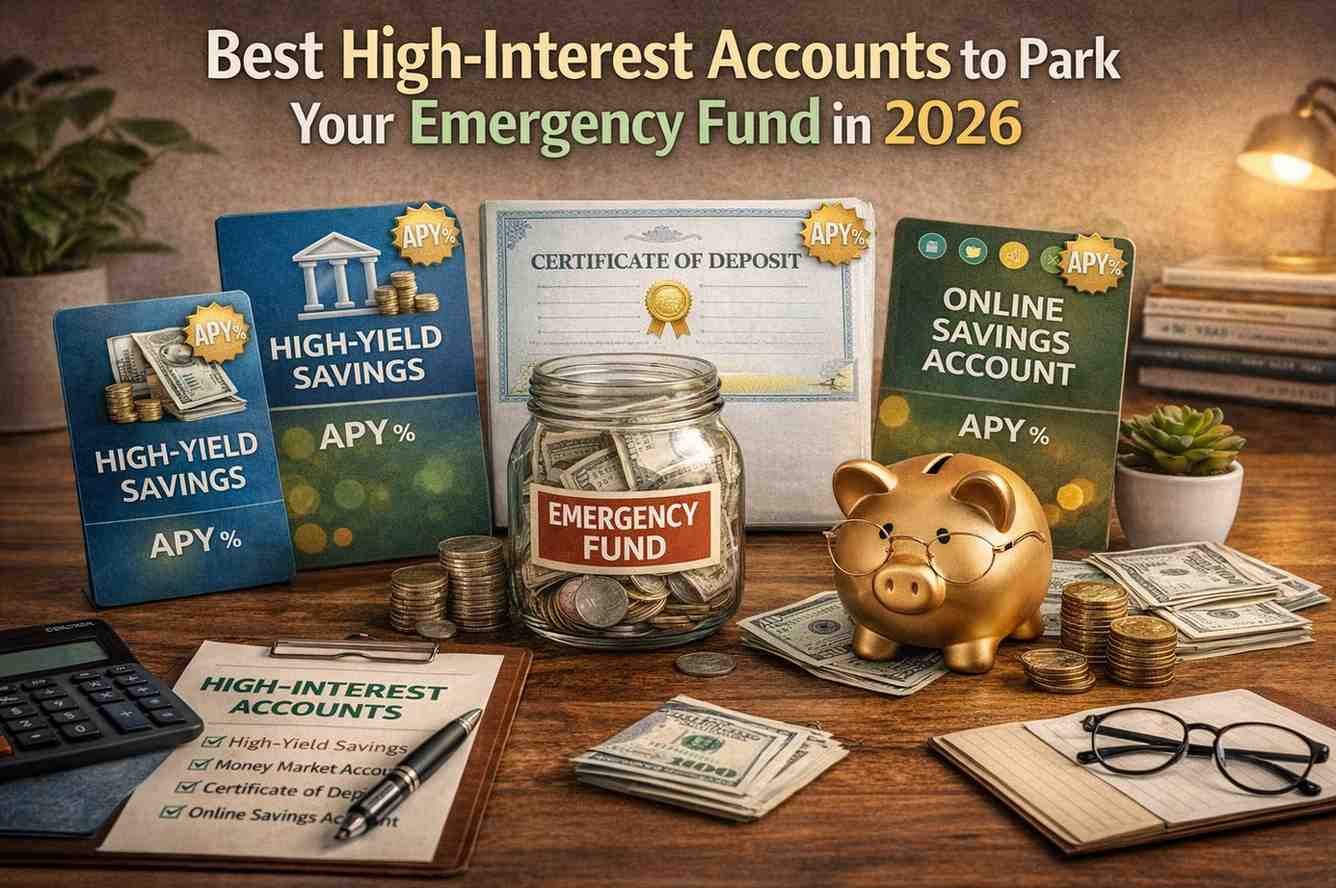
Introduction: Best High-Interest Accounts
When you finally build up an emergency fund, the next question hits almost immediately: where exactly should this money sit?
Leaving it in a basic checking account feels wasteful. Putting it somewhere too risky defeats the whole purpose. And with so many account types out there, it’s genuinely hard to know which ones are worth your attention and which ones are just marketing noise.
The best high-interest accounts in 2026 offer a real balance between accessibility, safety, and a return that at least keeps pace with — or edges ahead of — inflation. This article breaks down each option clearly, explains who each one suits best, and helps you make a decision that actually fits your situation.
Why Where You Park Your Emergency Fund Matters
Most people spend months building an emergency fund and then just… leave it somewhere without much thought. A standard savings account at a big national bank. A checking account. Sometimes a physical envelope.
None of those choices are working for you.
The whole point of finding the best high-interest accounts for your emergency fund is that your money should be doing something while it waits. Not taking big risks — just quietly growing at a rate better than near-zero.
In 2026, the spread between a basic savings account at a traditional bank and a competitive high-yield option can be significant. On a $10,000 emergency fund, the difference between 0.01% APY and 4.5% APY is roughly $449 per year. That’s real money for doing nothing differently except choosing a better account.
What Makes an Account Right for Emergency Savings
Before listing the best high-interest accounts, it’s worth being clear about what criteria actually matter for emergency fund storage specifically.
Liquidity. You need to be able to access the money within one to three business days. An account that locks your money away for months at a time isn’t suitable as your primary emergency fund storage.
Stability. The balance should not go down. Stocks and ETFs can earn more but they also drop in value. Your emergency fund cannot be subject to market risk.
FDIC or NCUA insurance. Up to $250,000 per depositor, per institution. This protects your money if the bank or credit union fails. Any account worth considering should have this protection.
Competitive yield. Higher than a basic savings account, but not so high that it comes attached to excessive restrictions or risk.
Keep these four criteria in mind as you evaluate each account type below.
High-Yield Savings Accounts — The Most Practical Choice for Most People
If you ask any financial educator about the best high-interest accounts for emergency funds, high-yield savings accounts (HYSAs) will almost always come up first. There’s a reason for that.
Online banks and credit unions — which have lower overhead than traditional brick-and-mortar banks — routinely offer APYs that are dramatically higher than what you’d get at a major national bank. In 2026, competitive HYSAs are offering rates in the range of 4.00% to 5.00% APY, though this fluctuates with Federal Reserve decisions.
The mechanics are simple. You deposit money. It earns interest monthly. You can transfer it back to your checking account within one to two business days when you need it.
There’s no complicated process, no investment risk, and no penalty for withdrawing. FDIC insurance applies.
The main thing to watch: rates aren’t locked in. If the Fed cuts rates, your HYSA yield drops too. That’s not a dealbreaker, but it’s worth knowing upfront.
What to Look For in a High-Yield Savings Account
When comparing the best high-interest accounts in the HYSA category, pay attention to:
- Current APY (and whether it’s a promotional rate that expires)
- Minimum balance requirements
- Monthly fees, if any
- Transfer speed to your main bank
- Mobile app quality if you prefer managing things on your Android phone
Several online banks have no minimum balance and no monthly fees, which makes them accessible regardless of how much you’re starting with.
Money Market Accounts — Flexibility With Competitive Returns
Money market accounts (MMAs) sit in an interesting middle position among the best high-interest accounts. They typically offer yields comparable to high-yield savings accounts, but they come with additional access options — often including a debit card or check-writing privileges.
This added flexibility can be genuinely useful. If you ever need your emergency fund fast and a bank transfer feels too slow, having a debit card connected to the account provides a more immediate path.
The tradeoff is that money market accounts sometimes come with higher minimum balance requirements. Some require $1,000, others $2,500 or more to earn the advertised rate or avoid fees. Below that threshold, fees can quietly eat into your returns.
For someone with a fully built emergency fund — say $8,000 to $15,000 — a money market account can be one of the best high-interest accounts because the minimum balance is easily maintained and the flexibility adds genuine convenience.
For someone just starting to build their fund, the minimum balance requirement might make a HYSA a more practical starting point.
Cash Management Accounts — A Modern Option Worth Knowing
Cash management accounts are relatively newer products, typically offered through brokerage firms and fintech companies rather than traditional banks. They function like a hybrid between a checking account and a savings account.
Many cash management accounts offer competitive yields — sometimes among the best high-interest accounts available in a given month — and come with features like debit cards, direct deposit support, and FDIC insurance through partner bank arrangements.
The appeal for emergency fund storage is real: good rates, easy access, and FDIC protection. Some even offer higher insurance limits than traditional banks by spreading deposits across multiple partner institutions.
The slight downside is that these accounts exist outside the traditional banking structure, which some people find unfamiliar or less reassuring. If you prefer managing everything through a single established bank, a cash management account may feel like an extra layer of complexity.
But if you’re already comfortable with app-based financial management — like most people who handle their finances on an Android phone — cash management accounts deserve a serious look when comparing the best high-interest accounts.
Short-Term Certificates of Deposit — Higher Rates With a Timing Trade-Off
Certificates of deposit offer some of the best high-interest accounts rates available, full stop. In 2026, short-term CDs — particularly 3-month and 6-month terms — have been offering competitive yields that often beat standard savings accounts.
The catch, which is a real one for emergency funds, is the lock-up period. If you withdraw money before the CD matures, you typically pay an early withdrawal penalty — often several months of earned interest.
This makes traditional CDs a poor choice as your only emergency fund storage. But as part of a layered strategy, they work well.
The CD Ladder Approach
A CD ladder involves splitting your emergency fund across multiple CDs with staggered maturity dates. For example:
- $2,000 in a 3-month CD
- $2,000 in a 6-month CD
- $2,000 in a 9-month CD
As each one matures, you roll it over into a new CD or access it if needed. At any given time, you have a CD coming due relatively soon, which limits how long you’d ever be locked out of your money.
This strategy captures some of the best high-interest accounts rates while maintaining reasonable liquidity through staggered access.
If you want to explore whether a CD ladder approach fits your emergency fund structure, Bankrate’s CD ladder calculator is a genuinely useful tool for mapping out the timeline.
Treasury Bills — Government-Backed With Tax Advantages
U.S. Treasury bills are short-term government securities available in 4-week, 8-week, 13-week, and 26-week terms. They’re purchased at a discount and pay face value at maturity — the difference is your return.
T-bills have been offering competitive yields in 2026, and they carry one advantage that savings accounts don’t: interest is exempt from state and local taxes. For people in high state-tax states, this can make T-bills effectively more competitive than even the best high-interest accounts on an after-tax basis.
You can buy T-bills directly through TreasuryDirect.gov with a minimum of $100.
The limitation for emergency fund use is liquidity. T-bills don’t mature for weeks to months, and selling early requires using a brokerage, which adds a step. For this reason, T-bills work best as a secondary layer of emergency savings — not the first layer you’d reach for in a crisis.
Accounts to Avoid for Emergency Fund Storage
It’s worth being direct about options that consistently underperform when compared to the best high-interest accounts for this purpose.
Traditional savings accounts at major national banks. Many of these still offer APYs of 0.01% to 0.10% — essentially zero. On a $10,000 balance, that’s $10 per year. There’s no reason to accept this when better options exist.
Checking accounts. No meaningful interest, and too accessible for daily spending impulses to leave your emergency fund untouched.
Stock market investments. Higher potential return, but subject to market volatility. Your emergency fund could drop 20–30% in value during a market downturn — exactly when you might need it most.
Long-term CDs (2+ years). The lock-up period is simply too long for funds that need to be accessible.
How to Choose the Right Account for Your Situation
With so many options described as the best high-interest accounts, narrowing down what’s right for you comes down to a few personal factors.
How large is your emergency fund currently? Small fund just starting out → HYSA with no minimum. Larger fund fully built → money market account or layered approach including CDs or T-bills.
How quickly might you need the money? If your income is variable or your expenses are unpredictable, prioritize liquidity. If you have a stable job and modest fixed costs, you can afford a slightly less liquid setup for part of the fund.
Are you comfortable with online-only banking? Most of the best high-interest accounts are offered by online institutions. If you strongly prefer branch access, look for credit unions in your area — many offer competitive rates and in-person service.
Do state taxes matter in your calculation? If you live in a high state-income-tax state, T-bills might be more attractive than their face rate suggests once you account for the tax exemption.
There’s no single universally correct answer. The best high-interest accounts for your emergency fund are the ones that match your access needs, your comfort level, and your current fund size.
Checking Rates Regularly Is Worth the Effort
Interest rates aren’t static. The landscape of the best high-interest accounts shifts as the Federal Reserve adjusts its benchmark rate. An account offering 4.8% APY today might offer 3.5% in six months if conditions change.
This doesn’t mean you should be constantly moving money around — that gets exhausting and counterproductive. But doing a quick comparison once or twice a year makes sense. Switching to a better account is usually straightforward and often takes less than 30 minutes.
Keeping an eye on rate comparison sites helps. Bankrate’s savings account comparison tool updates regularly and gives you a realistic current picture without requiring you to visit dozens of individual bank websites.
Final Conclusion
Finding the best high-interest accounts for your emergency fund in 2026 isn’t about chasing the highest possible number. It’s about finding the right combination of competitive yield, genuine accessibility, and solid protection for money that needs to be there when life gets difficult.
For most people, a high-yield savings account is the strongest starting point — no minimum balance, FDIC insured, competitive rate, and accessible within a couple of business days. Money market accounts add flexibility for those with larger balances. Short-term CDs and T-bills work well as supplementary layers for those wanting to optimize returns without sacrificing too much liquidity.
What to avoid is equally clear: basic savings accounts earning near-zero, and anything subject to market risk.
Your emergency fund worked hard to accumulate. The best high-interest accounts make sure it works a little harder while it waits.