 Jayk1@gmail.com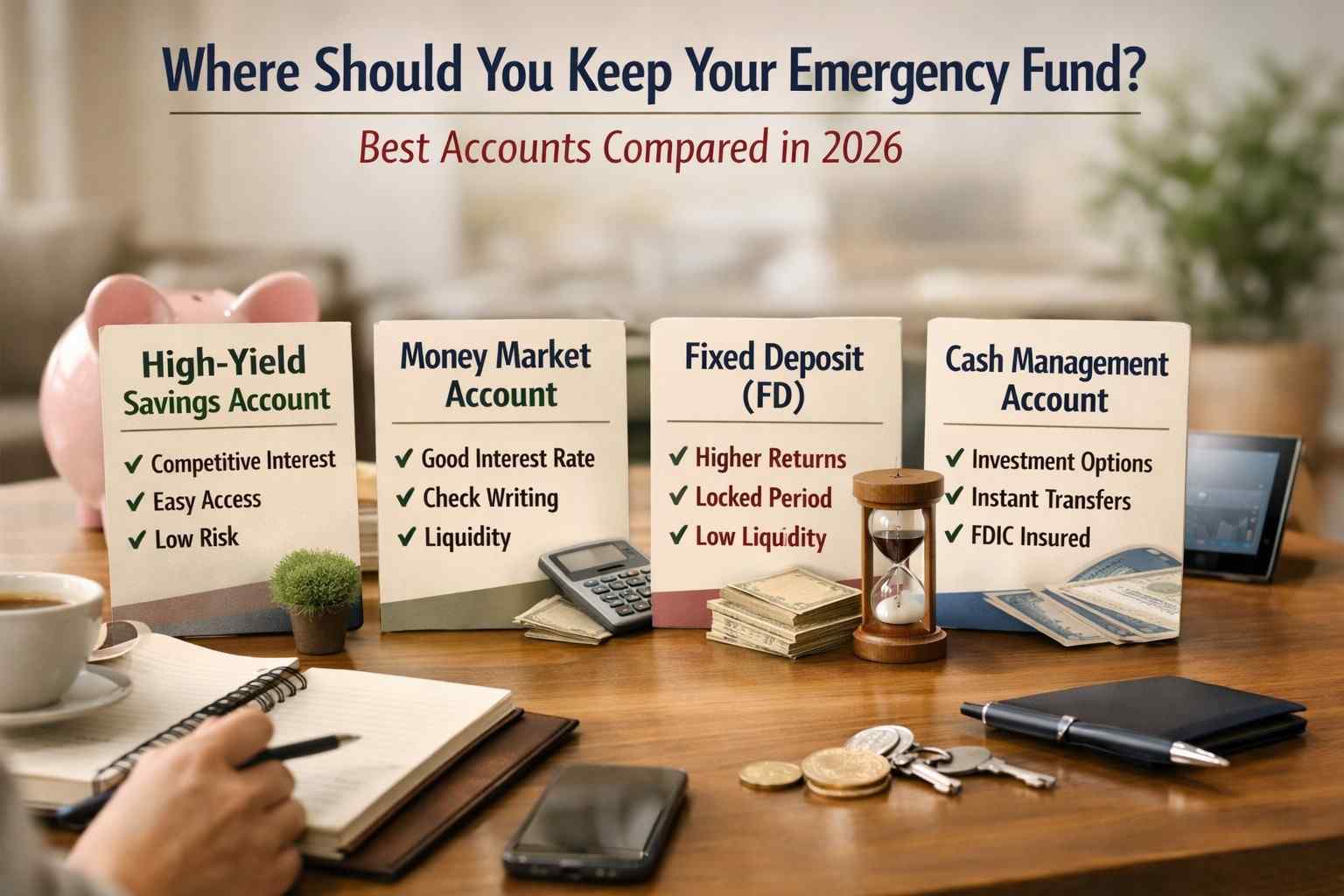
Introduction: Where Should You Keep Your Emergency Fund
Most people know they should have an emergency fund. But very few actually think hard about where to keep it. That second part matters more than most financial blogs will tell you.
If your emergency money is sitting in the wrong place — too easy to spend, too hard to access, or quietly losing value to inflation — then you don’t really have an emergency fund. You have a false sense of security.
This article walks you through the best account options available in 2026, explained in plain language. No jargon, no fluff.
Why the Location of Your Emergency Fund Actually Matters
Think of it this way. You wouldn’t store a fire extinguisher inside a locked safe, would you? It needs to be close, accessible, but not so in-your-face that you grab it for minor things.
Your emergency fund works the same way. It has to be:
- Accessible within 1–3 business days at most
- Separate enough from your daily spending that you don’t dip into it
- Earning something while it sits there
The question of where should you keep your emergency fund is really a question of balance — between safety, access, and growth.
How Much Should Be in Your Emergency Fund First?
Before comparing accounts, let’s make sure we’re on the same page about size.
Most financial advisors suggest keeping 3–6 months of essential expenses. If you have unpredictable income or work freelance, push that to 6–9 months. Think rent, groceries, utility bills, basic transportation — not your Netflix subscription.
Once you know your target number, then you figure out where to keep it.
High-Yield Savings Accounts (HYSAs) — The Most Popular Choice
For most people asking where should you keep your emergency fund, a high-yield savings account is the default answer — and it’s a good one.
These accounts are offered by online banks and credit unions. In 2026, many HYSAs are still offering annual percentage yields (APYs) significantly higher than traditional savings accounts at big brick-and-mortar banks.
The key advantages:
Liquidity. You can transfer money to your checking account within 1–2 business days. Fast enough for most emergencies that aren’t happening right at midnight.
No market risk. Your balance doesn’t drop because the stock market had a rough week.
FDIC or NCUA insured. Up to $250,000 per depositor per institution. Your money is protected.
The downside? Interest rates on savings accounts move with the Federal Reserve. When rates drop, so does your yield. You don’t control that.
Still, for the majority of people, a high-yield savings account is probably the most sensible place to keep emergency savings. It checks most of the right boxes.
Traditional Savings Accounts — Familiar But Often Inefficient
Your regular savings account at a major national bank is technically a valid answer to where should you keep your emergency fund — but it’s not a great one in 2026.
Big banks have historically offered very low interest rates on savings, sometimes as little as 0.01% APY. That means on a $10,000 emergency fund, you’d earn roughly $1 a year. That’s not a typo.
The only real benefit here is convenience — especially if the account is linked to your checking account at the same bank. Transfers are instant.
But that convenience can also be a trap. When emergency savings are too easy to reach, people tend to raid them for non-emergencies. A new phone deal feels urgent when the money is two taps away.
If a traditional savings account is your only real option, it still beats keeping cash under your mattress. But it’s worth exploring other options before settling here.
Money Market Accounts — A Middle Ground Worth Considering
Money market accounts (MMAs) are a hybrid of sorts. They work similarly to savings accounts but often come with check-writing privileges and debit card access, while also offering competitive interest rates.
In 2026, several credit unions and online financial institutions offer money market accounts with decent yields — sometimes comparable to high-yield savings accounts, sometimes a bit lower.
When thinking about where should you keep your emergency fund, a money market account makes sense if:
- You want slightly more flexible access (a debit card or checks)
- You’re comfortable with slightly higher minimum balance requirements
- You want everything in one FDIC/NCUA-insured account
They’re not dramatically better than HYSAs, but for some people the flexibility is worth the tradeoff.
Certificates of Deposit (CDs) — Strong Returns, But Be Careful
A CD is basically a deal you make with a bank. You agree to leave a set amount of money untouched for a fixed period — 3 months, 6 months, 1 year, 5 years — and in return, the bank pays you a higher interest rate than a regular savings account.
Here’s the problem with using a CD for emergency savings: if you need the money before the term ends, you’ll almost certainly pay an early withdrawal penalty. Sometimes that penalty wipes out months of earned interest.
That said, there’s a strategy called a CD ladder that some people use smartly. You split your emergency fund across several CDs with staggered maturity dates. For example:
- $2,000 in a 3-month CD
- $2,000 in a 6-month CD
- $2,000 in a 12-month CD
As each one matures, you roll it over or access it if needed. This way, you always have something coming due soon.
For where should you keep your emergency fund, a CD ladder can work as a secondary layer — not as your only emergency account. Keep your core 1–2 months of expenses somewhere fully liquid, and use the CD ladder for the rest.
Treasury Bills and Government Securities — Worth a Look in 2026
This one surprises people. Short-term U.S. Treasury bills (T-bills) — particularly 4-week, 8-week, or 13-week bills — have been offering competitive yields, and the interest is exempt from state and local taxes.
You can buy T-bills directly through TreasuryDirect.gov with as little as $100.
For someone wondering where should you keep your emergency fund and who wants slightly better returns without touching the stock market, T-bills are a genuinely underrated option. They’re backed by the U.S. government, so default risk is essentially zero.
The catch: they’re slightly less liquid than a savings account. You’d need to wait for the bill to mature, or sell it early through a brokerage (which adds a step). Not ideal if you need cash in 24 hours.
Again — works well as a secondary layer alongside a more liquid account.
What About Checking Accounts?
Keeping emergency savings in a checking account is not a good idea, and most people who’ve tried it know why.
It blends with your daily spending money. You see a higher balance and you spend more. There’s no psychological or financial separation.
The only exception: some banks now offer checking accounts with interest. If you have one of those and genuinely cannot open a separate account, at least keep a mental or physical record of what portion is your emergency fund and treat it as untouchable.
But ideally, separation is key.
Should You Ever Invest Your Emergency Fund?
This comes up a lot. The short answer: generally no, not for your core emergency fund.
Investing in stocks, ETFs, or mutual funds introduces market risk. If your emergency happens during a market downturn — which, historically, they sometimes correlate — you could be forced to sell investments at a loss.
Your emergency fund’s job is to be there, reliably, when you need it. Growth is a secondary concern.
Some people keep a small portion — maybe one month’s expenses — in a conservative investment account as a “tier 3” layer. But your core fund should stay in stable, insured accounts.
Comparing the Best Options Side by Side
Here’s a quick breakdown for someone figuring out where should you keep your emergency fund in 2026:
| Account Type | Liquidity | Yield | Risk | Best For |
|---|---|---|---|---|
| High-Yield Savings | High | Moderate–High | None | Most people |
| Traditional Savings | Very High | Very Low | None | Last resort |
| Money Market Account | High | Moderate–High | None | Flexible access |
| CD (Short-Term) | Low | High | Low | Secondary layer |
| T-Bills | Moderate | Moderate–High | None | Tax-conscious savers |
| Checking Account | Very High | Very Low | None | Not recommended |
A Simple Setup That Actually Works
If you’re starting from scratch, here’s a practical structure many people find useful:
Layer 1: 1 month of expenses in a high-yield savings account. Fully liquid, easy to reach.
Layer 2: 2–3 months of expenses in a money market account or short-term CD. A little less immediate, earns more.
Layer 3 (optional): 1–2 months in T-bills if you want to optimize yield without risk.
This way, where should you keep your emergency fund isn’t a single answer — it’s a layered strategy that balances access and return.
Final Conclusion: Where Should You Keep Your Emergency Fund
Deciding where should you keep your emergency fund isn’t just a minor detail. It directly affects whether that fund actually serves its purpose when life gets difficult.
For most people in 2026, a high-yield savings account remains the strongest core option — accessible, insured, and earning a decent return. Money market accounts are a solid alternative with added flexibility. Short-term CDs and T-bills work well as secondary layers for larger emergency funds.
What you want to avoid is keeping everything in a low-interest traditional savings account or your checking account where it’s too easy to spend. And please, don’t invest your emergency fund in the stock market hoping for extra returns. The whole point of this money is stability, not growth.
Start with what you can, keep it separate, and revisit your setup every year as interest rates and your financial situation change.