 Jayk1@gmail.com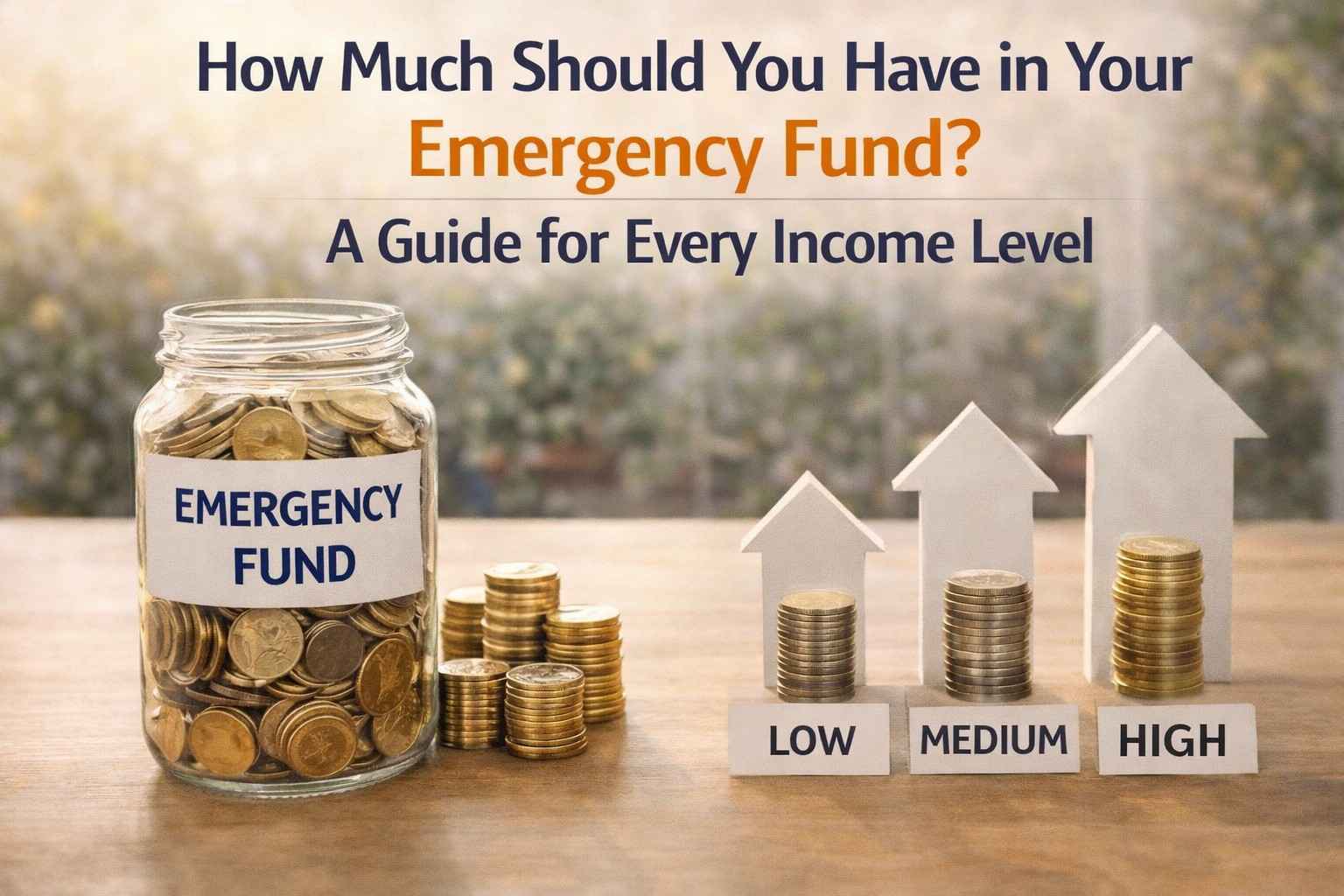
Introduction:
Ask ten different personal finance experts how much you should have in your emergency fund and you’ll likely get the same rehearsed answer — three to six months of expenses. It sounds clean and authoritative. The problem is, it tells you almost nothing useful about your specific situation.
Three to six months of expenses for someone earning ₹25,000 per month looks completely different from the same formula applied to someone earning ₹1,20,000. And both of those situations look different from a freelancer with no fixed income, a family with dependents, or someone with significant monthly debt obligations.
Understanding how much should you have in your emergency fund isn’t about applying a universal formula. It’s about understanding the variables in your own financial life and arriving at a number that genuinely protects you — not a number that sounds responsible in a financial advice article.
This guide walks through exactly that — income level by income level, situation by situation — so you leave with a real target number rather than a vague percentage range.
Why the Standard “3 to 6 Months” Advice Falls Short
The three to six month rule became popular because it’s simple and broadly applicable. For most people in stable employment with predictable expenses, it’s a reasonable starting framework. But it glosses over the factors that actually determine how much emergency coverage you personally need.
How much should you have in your emergency fund depends on things like: how stable your income is, whether you have dependents relying on your money, what your essential monthly expenses actually are, whether you have high-interest debt that complicates cash flow, and how quickly you could realistically replace your income if you lost your job tomorrow.
Someone with highly specialized skills, strong professional networks, and no dependents might be genuinely protected with two months of savings. Someone with irregular contract income, two children, aging parents, and a home loan EMI might need eight to twelve months to feel genuinely secure. The formula is the same but the right answers are completely different.
Step 1 — Calculate Your Actual Monthly Essential Expenses
Before answering how much should you have in your emergency fund, you need one foundational number: your real monthly essential expenses. Not total spending — essential spending only.
Essential expenses are the things that continue regardless of what happens to your income. Rent or home loan EMI. Groceries and cooking gas. Utility bills. Essential medications. Minimum debt payments. Basic transport to work. School fees if you have children.
Non-essential spending — dining out, entertainment, subscriptions, shopping, personal luxuries — doesn’t belong in this calculation. If an emergency hits and income stops, you’d cut these immediately. Your emergency fund only needs to cover what genuinely can’t wait.
Go through your last two months of transactions on your Android banking app and separate essential from non-essential with honest judgment. Most people find their essential monthly figure is 50 to 70% of their total spending — sometimes lower.
That essential monthly number becomes your base unit. Multiply it by your target months of coverage to arrive at your emergency fund goal.
How Much You Need Based on Income Level
For Monthly Income of ₹15,000 to ₹25,000
At this income level, the question of how much should you have in your emergency fund needs to be answered practically rather than theoretically. The standard three to six month target exists on a timeline that can feel discouraging when contributions are necessarily small.
Essential expenses at this income level typically run ₹10,000 to ₹18,000 per month depending on location, housing situation, and family structure.
Realistic target: Start with one month of essential expenses as your first firm goal — roughly ₹10,000 to ₹18,000. This single month of coverage handles most common emergencies: a medical bill, a vehicle repair, a sudden job gap of a few weeks.
Once that milestone is reached, build toward two months. Three months at this income level is a meaningful, genuinely protective emergency fund — most job searches resolve within that window even in difficult markets.
Don’t try to calculate six months’ worth and feel paralyzed by the distance. One month first. Always.
For Monthly Income of ₹25,000 to ₹50,000
This income range covers a large portion of salaried Indian professionals, and the answer to how much should you have in your emergency fund starts to depend heavily on employment type and family situation.
Essential expenses at this level typically range ₹18,000 to ₹35,000 per month. The standard three-month target — ₹54,000 to ₹1,05,000 — is achievable over 18 to 24 months of consistent saving without extreme sacrifice.
For single individuals with no dependents: Three months of essential expenses is genuinely sufficient. You have mobility, flexibility, and relatively low financial obligations. Job replacement is statistically faster for people without location or family constraints.
For married couples with one income: Push toward four months minimum. One income supporting two people means income loss creates immediate pressure on both. The extra month or two of coverage is worth the additional saving timeline.
For families with children or dependent parents: Four to five months is the right target. Dependents mean expenses don’t drop even when income does — which makes each covered month more valuable.
For Monthly Income of ₹50,000 to ₹1,00,000
At this income level, the calculation of how much should you have in your emergency fund becomes more nuanced because essential expenses are higher — but so is the capacity to build coverage faster.
Essential monthly expenses at this range typically run ₹35,000 to ₹65,000 once rent or EMI, household costs, children’s education, and other obligations are accounted for.
The baseline target: Three to four months of essential expenses — roughly ₹1,05,000 to ₹2,60,000 depending on your specific expense profile.
If you have a home loan EMI: This changes the calculation meaningfully. Missing an EMI has credit score consequences and potential penalty charges. Your emergency fund should be large enough to cover the EMI for the full duration of coverage — which often means the higher end of the range.
If you have aging parents with health conditions: Medical emergencies for parents can arrive with significant cost and zero warning. Budget at least one additional month of coverage beyond your baseline as a medical emergency buffer within your overall fund.
For Monthly Income Above ₹1,00,000
Higher income doesn’t automatically mean less need for emergency coverage — it often means higher essential expenses and more complex financial obligations.
When thinking about how much should you have in your emergency fund at this income level, the most important variables are employment stability and asset liquidity rather than just monthly expense coverage.
Essential monthly expenses at this income level can run ₹60,000 to ₹1,50,000 or more once housing costs, education, multiple EMIs, and lifestyle-maintenance expenses are factored in.
Standard target: Four to six months of essential expenses. The higher absolute number reflects higher monthly obligations that continue even when income stops — particularly home loans, car loans, and children’s education fees that have contractual payment requirements.
If self-employed or running a business: Six months minimum. Business income can drop suddenly and take time to rebuild. The emergency fund at this level isn’t just a personal financial cushion — it’s also protecting the stability of your business through slow periods.
Special Situations That Change the Calculation
Freelancers and Contract Workers
The standard guidance on how much should you have in your emergency fund assumes relatively stable employment. For freelancers, the entire calculation shifts.
Income gaps are a normal feature of freelance work, not emergencies. A month with no clients isn’t an emergency — it’s part of the income pattern. Which means a freelancer’s emergency fund needs to cover both genuine emergencies and the income variability that’s built into their work model.
Target: Six months of essential expenses as a minimum. Eight months is more comfortable. This might sound excessive compared to salaried advice, but it accounts for the reality that a three-month work gap is genuinely possible and not unusual in freelance and contract work.
Single Parents
Single parents asking how much should you have in your emergency fund need to account for a particularly vulnerable financial position — one income supporting children, with no second income as backup if something goes wrong.
The right target is five to six months of essential expenses, with a dedicated portion mentally earmarked for child-specific emergency costs — medical, educational, childcare disruption — that can arrive separately from income emergencies.
People With High-Interest Debt
This creates a genuine tension in the how much should you have in your emergency fund question. High-interest debt — credit card balances, personal loans above 15% interest — costs more per month than most emergency funds earn. Mathematically, paying down debt first makes sense.
The practical resolution: build a small emergency fund of ₹10,000 to ₹15,000 first — enough to handle minor emergencies without adding to the debt — then aggressively pay down high-interest debt before building full emergency coverage. Once the expensive debt is cleared, resume building toward your full target.
For a complete framework on how emergency fund contributions fit within a structured monthly plan, this guide on creating a monthly budget plan in 5 simple steps shows exactly how to balance competing financial priorities within a single monthly budget.
Where to Keep Your Emergency Fund
Answering how much should you have in your emergency fund is only half the question. Where you keep it matters too — specifically, it needs to be safe, accessible within 24 hours, and earning at least some interest rather than nothing.
High-Yield Savings Account
Small finance banks in India — Unity, Equitas, ESAF, AU Small Finance Bank — offer 6 to 9% annual interest on savings accounts, fully insured by DICGC up to ₹5,00,000. This is the most practical home for most emergency funds. Accessible via IMPS within hours, earning meaningful interest, and clearly separate from spending accounts.
Open a dedicated account specifically for this purpose through the bank’s Android app — the process takes 15 to 20 minutes with Aadhaar and PAN.
What to Avoid
Keeping emergency fund money in fixed deposits with penalty for premature withdrawal adds friction to accessing funds during a genuine emergency. The slightly higher interest rate isn’t worth the access delay.
Investing emergency fund money in mutual funds or stocks exposes it to market fluctuation — the worst time to need emergency money often coincides with market downturns. Emergency funds belong in stable, liquid accounts only.
Building Toward Your Target Without Feeling Overwhelmed
Once you know specifically how much should you have in your emergency fund for your situation, the gap between zero and that number can feel daunting — particularly on a moderate income.
The most effective approach is milestone-based building rather than fixating on the final target. Set ₹5,000 as the first milestone. Then ₹10,000. Then one month of expenses. Then two. Each milestone genuinely reduces your financial vulnerability, even before you reach the full target.
Automate your contribution on salary day — even ₹500 to ₹1,000 per month moving automatically to your dedicated emergency account builds the habit while the amount grows gradually. Set a standing instruction through your Android banking app so the transfer happens before spending decisions begin.
For practical strategies on finding contribution money within a tight monthly budget, this guide on how to start an emergency fund from zero on a low income covers specific approaches for finding savings within genuinely constrained finances.
Reviewing Your Target as Life Changes
Your answer to how much should you have in your emergency fund isn’t permanent. Life changes require target adjustments.
A new home loan increases your monthly essential expenses — your target should increase proportionally. A child being born adds dependent costs and reduces income flexibility — build the fund accordingly. A debt being paid off reduces monthly essential obligations — your target can reflect the lower essential expense figure.
Review your emergency fund target once a year at minimum. Also review after any significant financial life event: job change, new dependent, major new financial commitment, income increase or decrease.
Keep the current target written somewhere visible — a note on your Android phone works perfectly. When the actual balance matches the current target, set the next one. When the target changes because life changed, update the note and continue building.
Final Conclusion:
The question of how much should you have in your emergency fund doesn’t have one universally correct answer — but it does have a personally correct one, and this guide gives you the framework to find it.
Start with your actual essential monthly expenses. Factor in your employment stability, number of dependents, existing debt obligations, and income type. Apply the appropriate multiplier for your situation — and start building toward the first milestone rather than the final one.
The right emergency fund target for a single salaried professional with no dependents is genuinely different from the right target for a freelancer supporting a family. Both are valid. Both deserve honest calculation rather than a generic formula.
Open a dedicated high-yield savings account today. Set an automated monthly transfer for whatever amount is currently sustainable. Write down your first milestone and your final target. The specific amount you need is less important than the consistent movement toward it — because every rupee in that fund represents genuine financial protection that didn’t exist before you put it there.