 Jayk1@gmail.com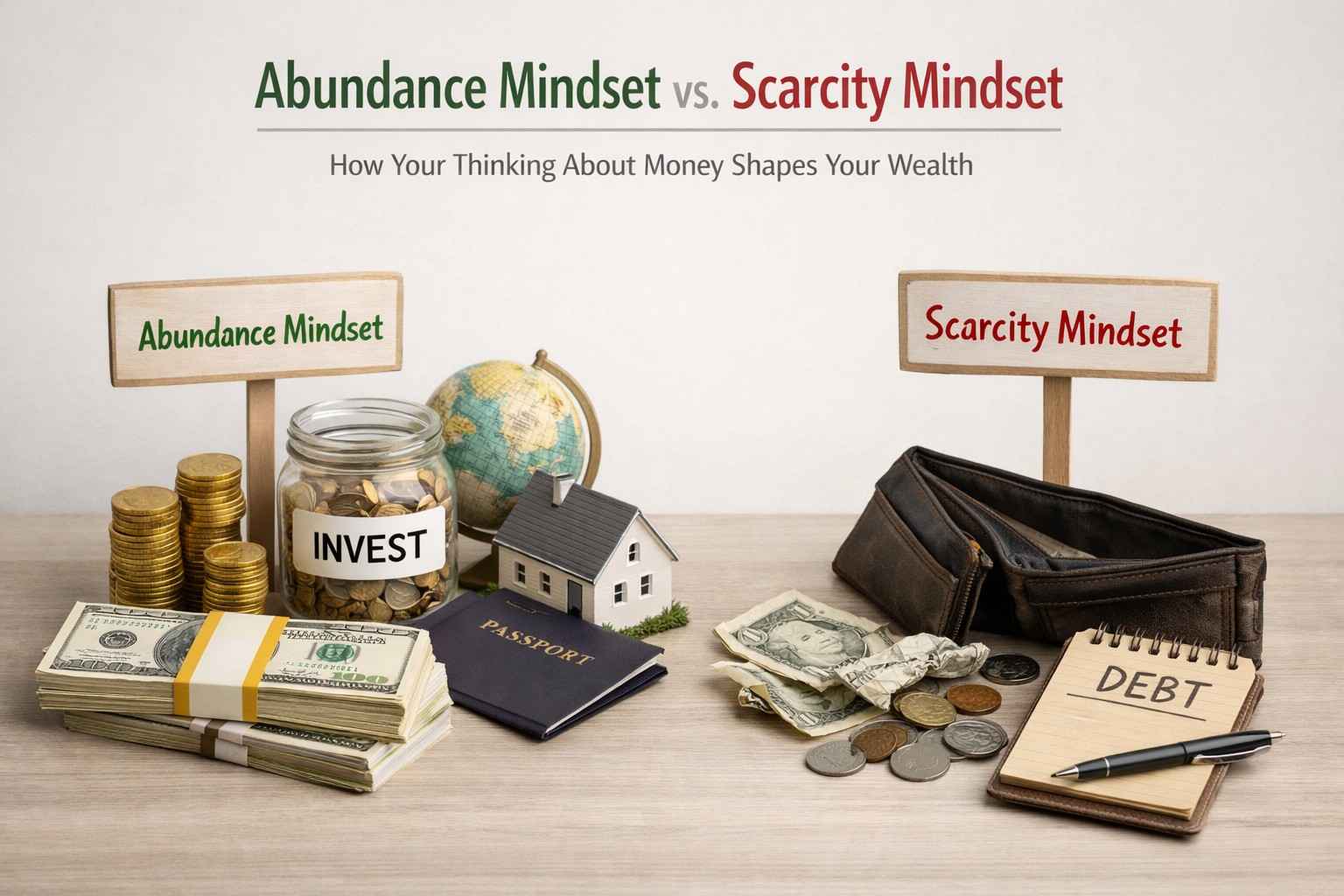
Introduction:
There’s a conversation most personal finance articles never have. They’ll tell you to budget better, invest earlier, spend less on things you don’t need. All practical, all useful. But they skip the part that actually determines whether any of that advice sticks.
The way you think about money.
Not your income. Not your education level. Not even your financial knowledge. The internal framework — the default assumptions your brain makes about money, opportunity, and your own potential — shapes your financial reality more than most people are comfortable admitting.
That framework comes down to two very different ways of seeing the world: the abundance mindset vs. scarcity mindset. Understanding the real difference between these two, and honestly identifying which one you’re operating from, is one of the most practical things you can do for your financial future.
The Core Difference Between These Two Ways of Thinking
Before getting into how these mindsets show up in money decisions specifically, it helps to understand what each one actually feels like from the inside.
The abundance mindset vs. scarcity mindset contrast isn’t really about optimism versus pessimism. It’s deeper than that.
A scarcity mindset operates from a core belief that resources — money, opportunity, stability — are fundamentally limited. That there’s only so much available, and if someone else has more, there’s somehow less for you. It creates a constant background hum of financial anxiety, even when things are technically okay.
An abundance mindset doesn’t mean you believe money falls from the sky or that everything will magically work out. It means you believe that financial improvement is genuinely possible, that your decisions matter, and that there are usually more options available than a scared mind can see in the moment.
The abundance mindset vs. scarcity mindset split is ultimately about whether you approach money from a place of fear or from a place of possibility. And that single difference quietly changes almost everything else.
How a Scarcity Mindset Actually Behaves in Real Life
It’s one thing to understand the concept. It’s another to recognize it in actual behavior — including your own.
The Anxiety That Doesn’t Match the Balance
One of the clearest signs of a scarcity mindset is persistent financial anxiety that doesn’t match your actual situation. People with this pattern often feel broke even when they aren’t, feel panicked about small expenses, or avoid looking at their bank balance because the number — whatever it is — feels threatening.
This isn’t irrational laziness. It’s a trained response. When you’ve grown up in an environment where money was always tight, always stressful, always the source of conflict — your nervous system learns to treat financial information as a threat. The scarcity side of the abundance mindset vs. scarcity mindset contrast lives in the body as much as in the mind.
Spending as Relief or Complete Avoidance
Scarcity thinking shows up in spending patterns in two opposite-looking ways that actually come from the same place.
Some people with a scarcity mindset spend impulsively — treating any available money as something that needs to be used before it disappears. “I have ₹3,000 left this month” becomes an invitation to spend it rather than save it, because on some level the belief is that it won’t last anyway.
Others go the opposite direction and avoid spending on anything, even genuinely useful things, because scarcity thinking makes every expense feel like a crisis.
Both are the abundance mindset vs. scarcity mindset difference in action — fear driving the bus, just in different directions.
Zero-Sum Thinking About Other People’s Success
Another pattern worth knowing: scarcity thinking often creates resentment toward others who are doing well financially. If you catch yourself feeling genuinely bothered — not inspired, but bothered — when someone you know buys a house or gets a promotion, that’s worth examining.
Scarcity thinking treats financial success as a fixed pie. Someone else’s slice means a smaller piece for you. Abundance thinking recognizes that’s not actually how opportunity works.
What an Abundance Mindset Looks Like in Practice
The abundance mindset vs. scarcity mindset comparison gets misunderstood here. Abundance thinking isn’t a state of constant positivity or a belief that everything will work out fine without effort. It’s more grounded than that.
Treating Setbacks as Information, Not Proof of Failure
Someone operating from an abundance mindset who has a bad financial month — overspent, missed a savings goal, dealt with an unexpected bill — processes it differently. They ask what happened, what they can adjust, and move forward.
Someone operating from scarcity uses the same bad month as confirmation of a belief they already held: “See, I knew I couldn’t do this. This is just how things are for me.”
The external event is identical. The internal response — shaped entirely by the abundance mindset vs. scarcity mindset framework — is completely different. And that response determines the next set of actions.
Willingness to Invest in Learning and Growth
People with an abundance mindset tend to see money spent on genuine skill development, financial education, or tools that improve their situation as investments rather than costs. They’re more willing to spend ₹500 on a course, or time learning how to use a budgeting app, because they believe the return is real.
Scarcity thinking sees those same expenses as risky or wasteful — because when resources feel permanently limited, spending on anything that isn’t immediately necessary feels dangerous.
Collaborative Rather Than Competitive
In the abundance mindset vs. scarcity mindset dynamic, abundance thinkers are generally more willing to share knowledge, connections, and information with others. They don’t experience other people’s success as a threat.
This matters financially because so many opportunities — freelance referrals, investment ideas, job leads, partnership possibilities — come through relationships. A scarcity mindset quietly closes those doors. Abundance thinking keeps them open.
Where These Mindsets Come From
Neither the abundance mindset nor the scarcity mindset appeared from nowhere. Understanding their origins makes it easier to be honest with yourself about which patterns are yours and why.
The Household You Grew Up In
This is the biggest one. The emotional climate around money in your childhood home does more to shape your financial mindset than almost anything else.
If money was a source of constant tension — arguments, stress, the phrase “we can’t afford that” used often — your nervous system encoded scarcity as the default. Not because anyone taught you that deliberately. Just because you lived it.
If money was handled with relative calm, talked about openly, and approached as something manageable rather than threatening — that gets absorbed too.
The abundance mindset vs. scarcity mindset split often starts here, before you ever held a job or opened a bank account.
Past Financial Experiences
Personal history matters too. If you’ve gone through real financial hardship — a period of genuine struggle, debt that felt overwhelming, watching a family member lose everything — those experiences leave marks.
Some people come out of hardship with fierce determination. Others internalize the experience as evidence that financial stability is simply not available to them. Both responses make sense. But only one of them leads forward.
Cultural and Social Messaging
The community and culture you grew up in also feeds into the abundance mindset vs. scarcity mindset question. Some environments treat financial ambition as admirable. Others treat it with suspicion, or associate wealth with moral failure. Some communities make talking about money openly completely normal. Others treat it as deeply private or even shameful.
These messages don’t just influence your opinions — they shape your unconscious relationship with money in ways that take real effort to identify.
How to Genuinely Shift From Scarcity to Abundance Thinking
This is not a section about repeating affirmations until you feel better. The abundance mindset vs. scarcity mindset shift is a real, gradual process that requires more than positive self-talk.
Step 1: Audit Your Actual Beliefs
Before you can change a belief, you have to see it clearly. Take 20 minutes with the notes app on your Android phone and honestly answer: What do I actually believe about whether people like me can build financial stability? What did money mean in my home growing up? What’s my gut reaction when I think about investing or saving?
You’re not trying to fix anything yet. You’re just mapping the terrain of your current abundance mindset vs. scarcity mindset position.
Step 2: Start Noticing the Thought Before the Decision
Most financial decisions are made quickly, almost automatically. The work is slowing down enough to catch the thought that preceded the behavior.
“I deserve this right now” before an impulse buy. “What’s the point” before skipping a savings transfer. “Someone like me can’t do that” before dismissing an opportunity without investigating it.
Catching these thoughts in real time is the actual work of shifting from the scarcity side of the abundance mindset vs. scarcity mindset divide toward something more functional.
Step 3: Collect Small Evidence That Contradicts Limiting Beliefs
This is underrated. Every time you follow through on a small financial commitment — transferring ₹500 to savings, tracking your spending for a week, making one extra loan payment — you’re building evidence that you are capable of managing money.
Your brain updates beliefs based on evidence. Give it better evidence to work with. That’s how the abundance mindset vs. scarcity mindset shift actually happens over time — not through one big revelation, but through accumulated small experiences that contradict the old story.
Step 4: Change Your Information Environment
What you regularly read, watch, and listen to about money shapes your unconscious beliefs about it. If your only exposure to financial topics is stress and crisis — news about economic collapse, conversations that treat money as inherently corrupting or out of reach — that feeds scarcity thinking.
Deliberately seek out resources that show ordinary people making real financial progress. For balanced, practical financial education, NerdWallet’s personal finance learning center offers grounded, accessible content that helps normalize financial improvement without unrealistic promises. The CFPB’s financial wellbeing resources are also worth bookmarking for their clear, no-pressure approach.
Step 5: Reframe How You Talk About Money to Yourself
Language matters more than it seems in the abundance mindset vs. scarcity mindset dynamic. The phrases you use internally about your financial situation shape how you feel about it, which shapes what you do about it.
“I can’t afford that” is a statement of permanent limitation. “That’s not a priority right now” is a statement of conscious choice. They describe the same situation but create completely different internal experiences.
This isn’t about fake positivity. It’s about accuracy. Most of the time, “I’m choosing not to spend on this right now” is actually more true than “I can never have this.”
Why Both Mindsets Affect More Than Just Money
Here’s something worth knowing: the abundance mindset vs. scarcity mindset difference doesn’t stay neatly contained to finances. It leaks into relationships, career decisions, creative risk-taking, and how you handle uncertainty in general.
Scarcity thinking in money often shows up as fear of career risk, reluctance to negotiate salary, avoidance of new financial information, and difficulty making decisions because every choice feels like something being permanently lost.
Abundance thinking tends to make people more willing to take calculated risks, negotiate, learn new things, and recover from setbacks with less damage to their self-concept.
When you shift one, the effects spread. That’s why understanding the abundance mindset vs. scarcity mindset question is genuinely foundational — not just for your bank account but for how you move through the world.
Final Conclusion
The abundance mindset vs. scarcity mindset isn’t a personality trait you’re stuck with. It’s a learned pattern — built up over years of experiences, environments, and absorbed messages about what money means and who gets to have it.
Understanding which side of the abundance mindset vs. scarcity mindset divide you’re currently operating from is the first real step toward changing it. Not through wishful thinking, but through honest self-examination, deliberate small wins, and a gradual accumulation of evidence that a different financial reality is genuinely available to you.
Your financial future isn’t just determined by your income or your investment choices. It’s shaped, quietly and consistently, by the thoughts you have about money before any of those decisions get made. Change the thinking, and the decisions start to change too.