
 Jayk1@gmail.com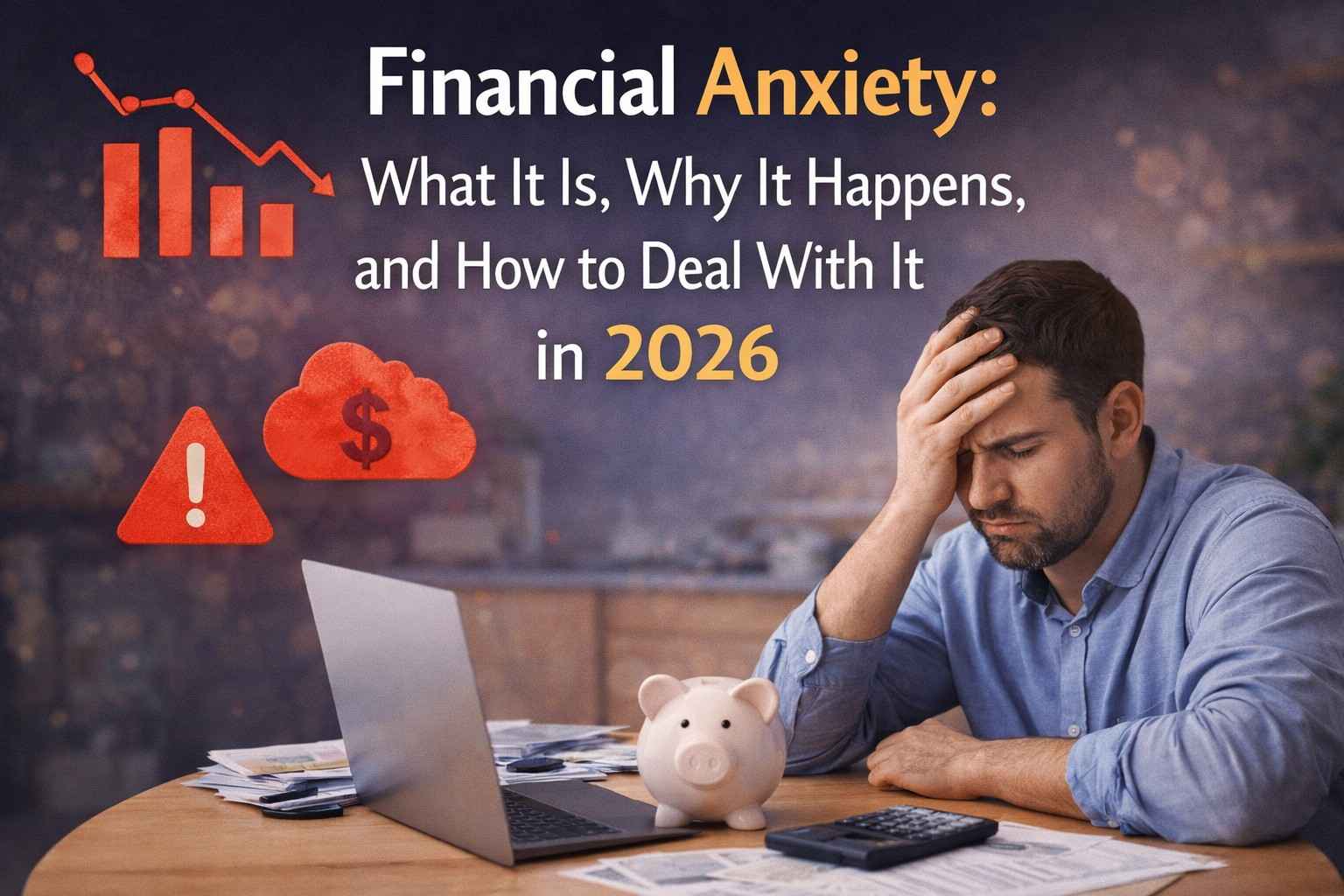
Introduction: Financial Anxiety
There’s a particular kind of dread that arrives on the last week of the month. The moment you open your banking app and feel your stomach tighten before the number even loads. The Sunday evening feeling when the work week is about to start and you’ve already begun mentally calculating what’s left, what’s due, what you can’t quite cover. The way a small unexpected expense — a medical bill, a vehicle repair, a phone screen crack — can send your nervous system into full alarm mode even when it’s technically manageable.
That experience has a name. It’s called financial anxiety. And in 2026, with the cost of living still pressing on most households and economic uncertainty still a regular feature of daily news, it’s affecting more people than ever — including many who would describe their financial situation as “okay, mostly.”
This article is about understanding what financial anxiety actually is, where it genuinely comes from, and how to address it in ways that are practical, honest, and grounded in how people actually experience money stress.
What Financial Anxiety Actually Is — Beyond Just Worrying About Bills
Financial anxiety gets confused with simply being stressed about not having enough money. But those aren’t the same thing. While financial hardship is real and genuinely difficult, financial anxiety refers to something more specific — a pattern of fear, worry, and avoidance around money that persists even when it’s disproportionate to the actual financial situation.
Someone with significant debt and very low income has legitimate, proportionate financial stress. But financial anxiety is what happens when the worry operates independently of the actual numbers — when someone with a stable income and a reasonable emergency fund still can’t stop catastrophizing about financial ruin, or when someone avoids their bank balance entirely because looking feels unbearable regardless of what it shows.
Both situations deserve attention. The distinction matters because the tools that help are somewhat different. Practical financial stress responds primarily to practical financial solutions. Financial anxiety responds to those too, but also requires addressing the psychological patterns that keep the worry active even when the external situation improves.
Why Financial Anxiety Is So Common in 2026
Understanding the current context for financial anxiety isn’t about excuses — it’s about recognizing the legitimate environmental factors that make this particular kind of stress so widespread right now.
The Cumulative Pressure of Economic Uncertainty
The last few years have delivered sustained economic pressure to most households — inflation that moved faster than wages in many sectors, post-pandemic financial disruption that hit some industries severely, and a housing market that kept homeownership out of reach for a significant portion of people who should theoretically have been able to access it.
Even for people who navigated those years reasonably well, the experience accumulated. The sense of financial ground shifting, of stability being less guaranteed than it once felt, left a residue. Financial anxiety thrives in environments where predictability feels unreliable — and predictability has felt genuinely unreliable for many people.
The Visibility of Other People’s Financial Lives
Social media has created a strange new dimension of financial anxiety that didn’t exist in the same form twenty years ago. People now have constant, curated visibility into the apparent financial lives of others — the holidays, the home renovations, the restaurant meals, the new cars, the apparent ease.
Most of what’s visible is curated beyond recognition. But it creates a continuous reference point against which people measure their own financial reality. And that comparison — which almost always makes your own situation look worse, because you’re comparing your full reality to someone else’s highlight reel — feeds financial anxiety in a way that’s genuinely hard to escape without deliberate effort.
The Gap Between Financial Knowledge and Financial Behavior
Many people in 2026 have more access to financial information than any previous generation — apps, articles, podcasts, YouTube channels covering every aspect of personal finance. And yet financial anxiety remains widespread, which tells you something important: knowing what to do is not the primary barrier for most people.
The barrier is the emotional relationship with money that makes it difficult to act on what you know. Financial anxiety creates avoidance, which creates information gaps, which worsens anxiety, which deepens avoidance. That cycle can run for years without any external trigger.
How Financial Anxiety Shows Up in Real Behavior
Financial anxiety doesn’t always look the same. It has several distinct behavioral expressions, and recognizing your own version is the first step toward addressing it.
Avoidance and Information Blackouts
One of the most common expressions of financial anxiety is simply refusing to engage with financial information. Not checking the bank balance. Not opening bills or loan statements. Not updating a budget or tracking spending. The avoidance provides short-term relief from the anxiety — if you don’t look, you don’t have to feel the discomfort of what you might see.
But avoidance is one of the most expensive coping strategies available, because it means every financial decision gets made without accurate information. Problems that could have been addressed early become crises because they were never observed.
Hypervigilance and Constant Calculation
The opposite pattern is also a form of financial anxiety — constant, compulsive monitoring of finances that consumes significant mental energy without actually producing better outcomes. Checking your bank balance multiple times a day. Running mental calculations repeatedly about whether bills will be covered. Catastrophizing about unlikely financial scenarios.
This pattern feels like being responsible, but it’s actually anxiety using the appearance of diligence as a vehicle. The repeated checking doesn’t change the numbers — it just keeps the nervous system in a state of activation.
Spending as Emotional Relief
Financial anxiety frequently drives spending rather than preventing it — which confuses both the person experiencing it and the people around them. When anxiety becomes unbearable, the brain looks for relief. Spending on something — anything — creates a temporary sense of agency and control that provides brief relief from the feeling of financial threat.
The purchase then makes the financial situation slightly worse, which increases the underlying anxiety, which increases the need for relief. This cycle is one of the more destructive expressions of financial anxiety and one of the harder ones to interrupt.
Difficulty Making Financial Decisions
Financial anxiety also shows up as decision paralysis — the inability to make financial choices because every option feels potentially catastrophic. Should I put extra money toward debt or savings? Should I change my investment allocation? Should I negotiate for a raise? The anxiety makes each decision feel so high-stakes that postponing indefinitely feels safer than choosing.
The Psychological Roots of Financial Anxiety
To actually address financial anxiety rather than just managing symptoms, it helps to understand where it’s coming from at a deeper level.
Early Conditioning Around Money
The most consistent root of financial anxiety in adults is the emotional environment around money in childhood. Not the explicit lessons — the felt experience. Whether money felt stable or threatening. Whether financial stress was a background hum or a constant alarm. Whether adults around you modeled calm financial management or responded to money with fear and conflict.
Children absorb emotional associations directly, without the cognitive capacity to contextualize them. The association between money and threat, once formed, runs in the nervous system long after the original circumstances have changed. That’s why financial anxiety often persists even when someone’s actual financial situation has improved significantly from their childhood context.
Past Experiences of Financial Crisis
Real financial hardship leaves real psychological marks. A period of serious debt, a job loss that created genuine instability, a financial crisis watched up close in someone’s family — these experiences become reference points the brain uses to predict the future.
“That happened before. It could happen again.” That prediction, running below conscious awareness, keeps the nervous system in a state of readiness for financial threat even in situations that don’t actually warrant it. That’s financial anxiety in its most clearly traceable form.
Generalized Anxiety That Attaches to Finances
For some people, financial anxiety is partly an expression of generalized anxiety that has found a particularly compelling object. Money is an area of life with real consequences, real uncertainty, and constant relevance — which makes it a natural target for anxious thinking that might otherwise attach to health, relationships, or safety.
In these cases, addressing financial anxiety may require working on the anxiety itself, not just its financial expression.
Practical Strategies for Managing Financial Anxiety in 2026
Understanding where financial anxiety comes from is the foundation. But practical strategies are what actually change the daily experience. These are the approaches that work — not because they’re dramatic, but because they address the real mechanisms driving the problem.
Create a Weekly Financial Check-In Ritual
One of the most effective interventions for financial anxiety — whether it’s showing up as avoidance or hypervigilance — is creating a structured, time-limited engagement with your finances once a week.
Not multiple times a day. Not never. Once a week, at the same time, for a fixed duration. Open your banking app on your Android phone on Sunday evening. Spend 15 minutes looking at what came in, what went out, and what’s coming up. Then close it and don’t check again until next Sunday.
For the avoider, this creates a manageable, regular contact with financial reality that gradually reduces the threat response. For the hypervigilant checker, it contains the monitoring behavior within a structure that doesn’t consume the whole week. Both versions of financial anxiety are served by the same basic intervention.
Name the Anxiety Without Judging It
Financial anxiety loses some of its power when it’s named explicitly rather than experienced as a vague, undifferentiated discomfort. When you notice the tight stomach before checking your balance, or the catastrophic thought spiral after an unexpected expense, try naming it directly in your notes app on your Android phone: “I’m feeling financial anxiety right now.”
That naming — simple as it sounds — activates the prefrontal cortex in a way that slightly reduces the intensity of the emotional response. It also separates you from the experience in a small but meaningful way. The anxiety is something you’re observing, not something you’re identical with.
Separate Financial Facts From Financial Stories
Financial anxiety consistently adds a narrative layer on top of financial facts that turns manageable information into catastrophic scenarios. “My account balance is lower than I’d like” becomes “I’m going to lose everything and end up in crisis.” “I overspent this month” becomes “I’m completely irresponsible and I’ll never get this right.”
A practical skill: when you notice financial anxiety arising, try to identify the actual fact versus the story you’re adding to it. The fact is neutral data. The story is what’s generating the distress. Practice working with the fact — what, concretely, can I do about this specific situation? — rather than engaging with the story.
Build a Minimal Viable Emergency Fund
One of the most direct and effective structural interventions for financial anxiety is having a small financial buffer that exists specifically to handle unexpected expenses without crisis.
You don’t need three months of expenses saved to feel a difference. Even ₹10,000 to ₹15,000 sitting in a separate savings account — most Indian banks allow you to open a secondary account through their mobile app in minutes — creates a meaningful psychological shift. It means that a minor unexpected expense doesn’t immediately threaten basic stability.
The existence of that buffer doesn’t eliminate financial anxiety entirely. But it removes one of its most consistent triggers — the constant exposure to financial fragility that keeps the nervous system in alert mode.
For guidance on building that initial emergency fund in practical, achievable steps, this resource from the Consumer Financial Protection Bureau on emergency savings is both beginner-friendly and genuinely actionable.
Reduce the Financial Comparison Environment
Given how significantly social media comparison feeds financial anxiety, deliberately reducing that comparison input is a practical and underrated intervention.
This doesn’t have to mean leaving platforms entirely. It means curating your feed with genuine intentionality — muting or unfollowing accounts that consistently produce feelings of financial inadequacy, and replacing them with content that normalizes the actual, imperfect financial lives of ordinary people.
It also means developing a clearer internal reference point for your own financial progress — measuring against your own past situation and your own stated goals rather than against what others appear to have.
Address the Pattern With Professional Support When Needed
Financial anxiety that is significantly interfering with daily life — sleep disruption, relationship strain, persistent avoidance that’s causing financial harm, or constant distress despite a factually stable financial situation — is worth bringing to a mental health professional who has experience with financial psychology or anxiety disorders more generally.
This isn’t an admission of weakness. It’s recognizing that some patterns are entrenched enough to require more than self-help strategies — particularly when the roots are in early conditioning or significant past trauma. Financial anxiety with those kinds of origins responds well to therapeutic approaches like cognitive behavioral therapy, which has strong research support for anxiety disorders generally.
For a broader framework on the connection between mental health and financial wellbeing, this resource from the National Alliance on Mental Illness provides a grounded, accessible overview that many people find helpful as a starting point for understanding when professional support might be the right next step.
Building Financial Confidence Alongside Managing Anxiety
Financial anxiety doesn’t just respond to anxiety-reduction techniques. It also responds to genuine increases in financial competence and confidence — because some of what drives the anxiety is the accurate perception of not knowing enough to navigate financial situations well.
Building financial knowledge — even slowly, even imperfectly — creates a sense of agency that directly counteracts financial anxiety. Understanding how your loan works. Knowing what your actual fixed expenses are. Having a basic sense of what financial terms mean. Each piece of knowledge reduces the sense of being at the mercy of systems you don’t understand.
This isn’t about becoming a financial expert. It’s about reducing the specific anxiety that comes from operating in an area of life that feels opaque and uncontrollable. Even modest increases in financial clarity tend to produce meaningful reductions in financial anxiety.
Final Conclusion
Financial anxiety is real, it’s widespread, and it’s not simply a reflection of financial irresponsibility or weakness. It has traceable causes in early conditioning, past experiences, and the genuine environmental pressures of the current economic moment. And it has real, practical interventions that make a measurable difference in daily experience.
The path through financial anxiety isn’t about achieving a perfect financial situation first and feeling calm afterward. It’s about developing a slightly more grounded relationship with financial information, building small structural buffers that reduce exposure to crisis, and gradually interrupting the thought patterns that turn financial facts into catastrophic stories.
Start with one thing this week. Create the weekly check-in. Open the separate savings account. Name the anxiety when it arises. Each small step creates the conditions for the next one. That’s how financial anxiety gets smaller over time — not through one dramatic resolution, but through the patient accumulation of more grounded experiences.