 Jayk1@gmail.com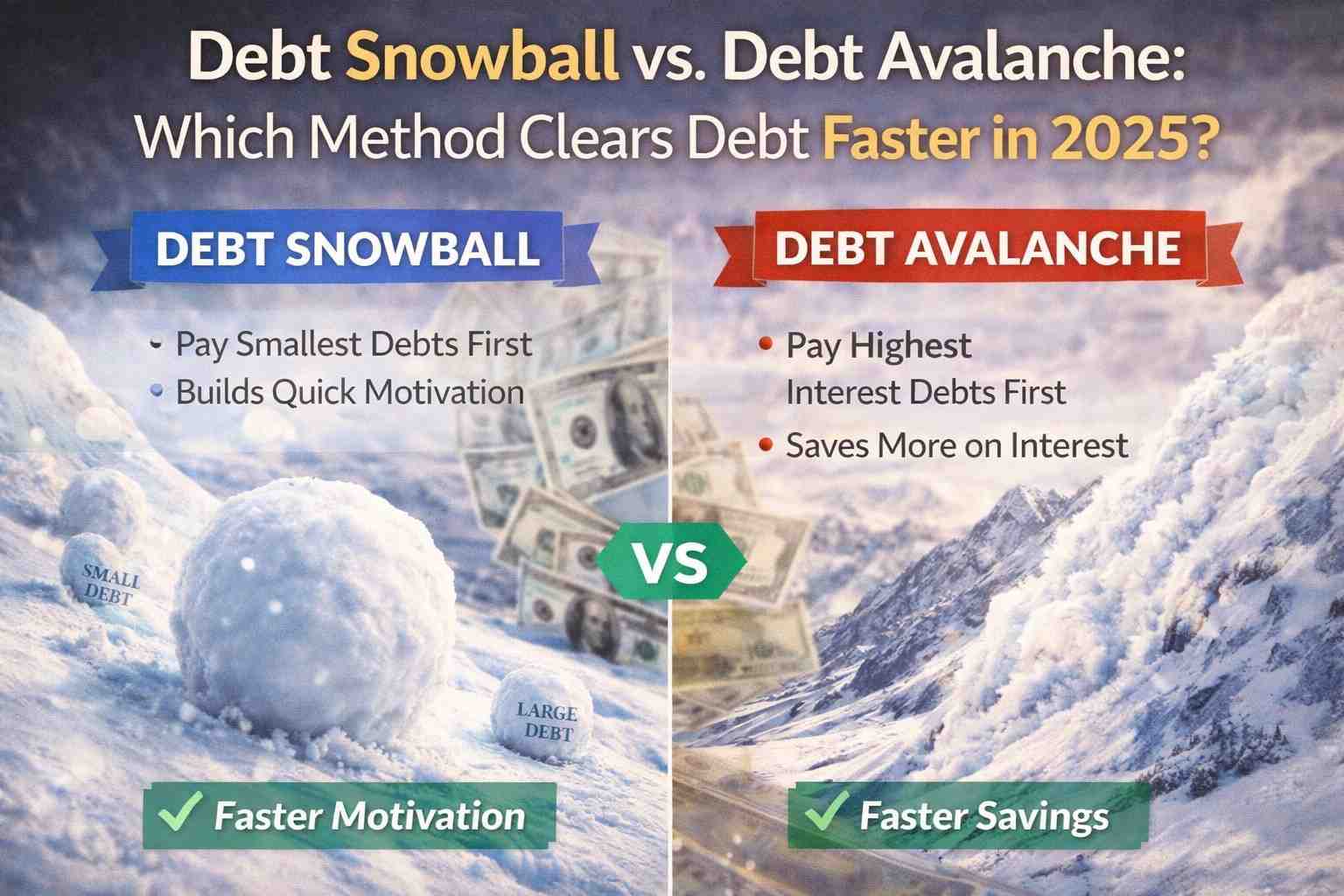
Introduction: Debt Snowball vs. Debt Avalanche
If you’ve ever tried to pay off multiple debts at once, you know how overwhelming it can feel. You’re juggling a credit card bill here, a personal loan there, maybe a car payment on top — and somehow your balance never seems to drop fast enough.
Two methods have been used for years to tackle exactly this problem: the debt snowball and the debt avalanche. Both work. Both have real fans. But they work in very different ways, and choosing the wrong one for your personality could mean giving up before you’re done.
This article breaks down Debt Snowball vs. Debt Avalanche honestly — no fluff, no sales pitch — so you can figure out which one actually fits your life in 2026.
What Is the Debt Snowball Method?
The debt snowball method is simple. You list all your debts from the smallest balance to the largest. Then you focus all your extra payment capacity on the smallest one first — while paying minimum amounts on everything else.
Once that smallest debt is gone, you take everything you were paying on it and add it to the next smallest. And so on. The payments stack up like a rolling snowball, growing bigger as it moves forward.
Quick example:
Say you have three debts:
- Credit card A: ₹8,000
- Personal loan: ₹35,000
- Car loan: ₹1,20,000
With the snowball method, you’d attack the ₹8,000 credit card first, regardless of the interest rate attached to it.
The logic isn’t mathematical. It’s psychological. Clearing a debt completely — even a small one — gives you a genuine sense of progress. That feeling keeps people going when motivation drops, which it always does at some point.
What Is the Debt Avalanche Method?
The debt avalanche method takes a different approach. Instead of ordering debts by balance size, you order them by interest rate — highest to lowest.
You throw all your extra money at the debt costing you the most interest each month. Minimum payments go on the rest. When the highest-rate debt is gone, you move to the next highest, and so on.
Using the same example:
If your credit card A charges 36% interest, your personal loan charges 18%, and your car loan charges 10%, the avalanche method says — tackle the credit card first, regardless of balance size.
Mathematically, this is the smarter move. You’re cutting off the most expensive debt at the root. Over time, you pay less total interest compared to the snowball approach.
But here’s the catch. If your highest-interest debt also has a large balance, it could take months — or even a year or more — before you see it disappear. For a lot of people, that wait kills momentum.
Debt Snowball vs. Debt Avalanche: The Core Difference
When comparing Debt Snowball vs. Debt Avalanche, it really comes down to one question: do you need to feel wins quickly, or are you disciplined enough to stay focused on a long game?
The snowball gives you early wins. You clear debts faster in terms of number of accounts closed, which feels great. But you might end up paying more interest overall because you’re ignoring high-rate balances while you work on smaller ones.
The avalanche saves you more money in total. But the early phase can feel slow, especially if your highest-interest debt has a large balance attached to it.
Neither method is universally better. They serve different types of people. And in 2026, with interest rates still elevated across credit cards and personal loans in many countries, the difference in total interest paid between the two methods can be quite significant.
Which One Saves More Money?
Let’s be straightforward here. The Debt Avalanche wins mathematically — almost every time.
When you eliminate high-interest debt first, you stop that interest from compounding on a large balance. Every rupee or dollar of interest you avoid is money that stays in your pocket instead of going to a lender.
Depending on your total debt amount and the spread of interest rates, the avalanche method could save you anywhere from a few thousand to tens of thousands in interest payments over the life of your repayment journey.
For people who are detail-oriented, financially motivated, and don’t need emotional checkpoints to stay on track — the avalanche is genuinely the stronger choice. If you want to understand more about how interest works on different loan types, reading up on how compound interest affects personal loans can help you see why attacking high-rate debt first matters so much.
Which One Do People Actually Stick To?
This is where the Debt Snowball fights back — and honestly, it wins on real-world follow-through.
Research in behavioral finance consistently shows that people need visible progress to maintain habits. Paying off a ₹12,000 credit card in three months feels like an achievement. Your brain registers it. You get a small boost of confidence. You move forward with more energy.
Compare that to chipping away at a ₹90,000 high-interest loan for 14 months before it disappears. The avalanche might be saving you money in theory, but if you abandon the plan at month six out of frustration — you end up worse off than someone who stuck with the snowball.
The best debt repayment method is the one you actually complete. That’s not a cliché. That’s the real answer to the Debt Snowball vs. Debt Avalanche debate when you look at how humans actually behave with money.
How to Choose the Right Method for You in 2026
Here are some honest questions to ask yourself before picking a side.
Do You Struggle With Motivation Over Long Periods?
If you’ve started and stopped financial plans before, the snowball is probably safer for you. The quick wins will keep you engaged. There’s no shame in admitting you need that — most people do.
Are Your Interest Rates Dramatically Different?
If most of your debts carry similar interest rates, the mathematical difference between the two methods becomes much smaller. In that case, the snowball’s psychological benefits might outweigh the minimal extra interest cost.
But if one debt carries 34% interest and another carries 11%, that gap is too large to ignore. The avalanche starts to make much more sense.
Do You Have a Large, High-Interest Balance?
This is the scenario where the Debt Snowball vs. Debt Avalanche question gets trickiest. If your highest-interest debt is also your largest balance, the avalanche method will feel painfully slow at first.
One practical workaround: use the snowball to clear two or three small debts quickly, which simplifies your payment landscape and frees up cash. Then shift to the avalanche approach for the remaining larger debts. This hybrid isn’t cheating — it’s being realistic about how your brain and your budget work together.
A Real-Life Scenario Comparison
Let’s say you have four debts in 2026:
- Credit card 1: ₹6,000 at 30% interest
- Credit card 2: ₹22,000 at 36% interest
- Personal loan: ₹50,000 at 18% interest
- Bike loan: ₹80,000 at 12% interest
And you have ₹4,000 extra per month to put toward debt repayment after minimums.
Snowball order: Credit card 1 → Credit card 2 → Personal loan → Bike loan
Avalanche order: Credit card 2 → Credit card 1 → Personal loan → Bike loan
The snowball gets you your first win (₹6,000 card) in roughly 2 months. Feels great. Keeps you going.
The avalanche saves you probably ₹4,000–₹7,000 in total interest paid across the full repayment period, depending on exact timelines.
Neither result is dramatic enough to call one method “clearly superior” in this scenario. But if credit card 2 had a ₹60,000 balance instead of ₹22,000, the avalanche savings would be much more substantial.
Context matters enormously in the Debt Snowball vs. Debt Avalanche conversation.
What Actually Works Better in 2026 Specifically?
Interest rates in 2026 are something to take seriously. Credit card rates in India, for example, commonly run between 28–42% annually. That’s not a small number. At those rates, every month you delay attacking the highest-interest balance costs you real money.
For people carrying high-rate credit card debt specifically, the avalanche method deserves serious consideration — even if it feels harder at first.
That said, with so many people carrying multiple debts from the post-pandemic period and rising cost of living, emotional sustainability is more important than ever. Burnout on a repayment plan is real. Understanding personal budgeting basics can help you structure your monthly payments in a way that makes either method more sustainable long-term.
If you’re newer to structured debt repayment or have never successfully stuck to a financial plan for more than a few months — start with the snowball. Get the habit locked in. Then consider shifting to avalanche logic once you’re in a rhythm.
Common Mistakes People Make With Both Methods
Regardless of which side of the Debt Snowball vs. Debt Avalanche debate you land on, there are mistakes that derail both approaches.
Adding new debt while repaying old debt. This is the most common one. You’re paying down a credit card and then using it again. You end up running in place.
Not paying at least the minimum on everything else. Both methods require minimum payments on all non-priority debts. Missing those creates late fees and damages your credit score, which makes future borrowing more expensive.
Choosing a method based on what sounds impressive. Some people pick the avalanche because it sounds financially sophisticated. Some pick the snowball because a financial influencer told them to. Neither is a good reason. Pick based on your actual behavior patterns.
For a deeper look at how your credit behavior affects your overall financial health, it’s worth reviewing how credit utilization impacts your credit score — something that’s relevant whichever repayment method you choose.
Final Conclusion: Debt Snowball vs. Debt Avalanche
The Debt Snowball vs. Debt Avalanche debate doesn’t have a universal winner — and anyone who tells you otherwise is oversimplifying things.
The avalanche saves money. The snowball saves motivation. And depending on who you are, both of those things have real value.
If you’re disciplined, math-driven, and can tolerate slow early progress — go avalanche. If you need early wins to stay consistent, go snowball. If your situation is complicated, blend the two.
What matters most isn’t which method is theoretically better. It’s which one you’ll actually finish. That’s the real answer in 2026 and every year before and after it.