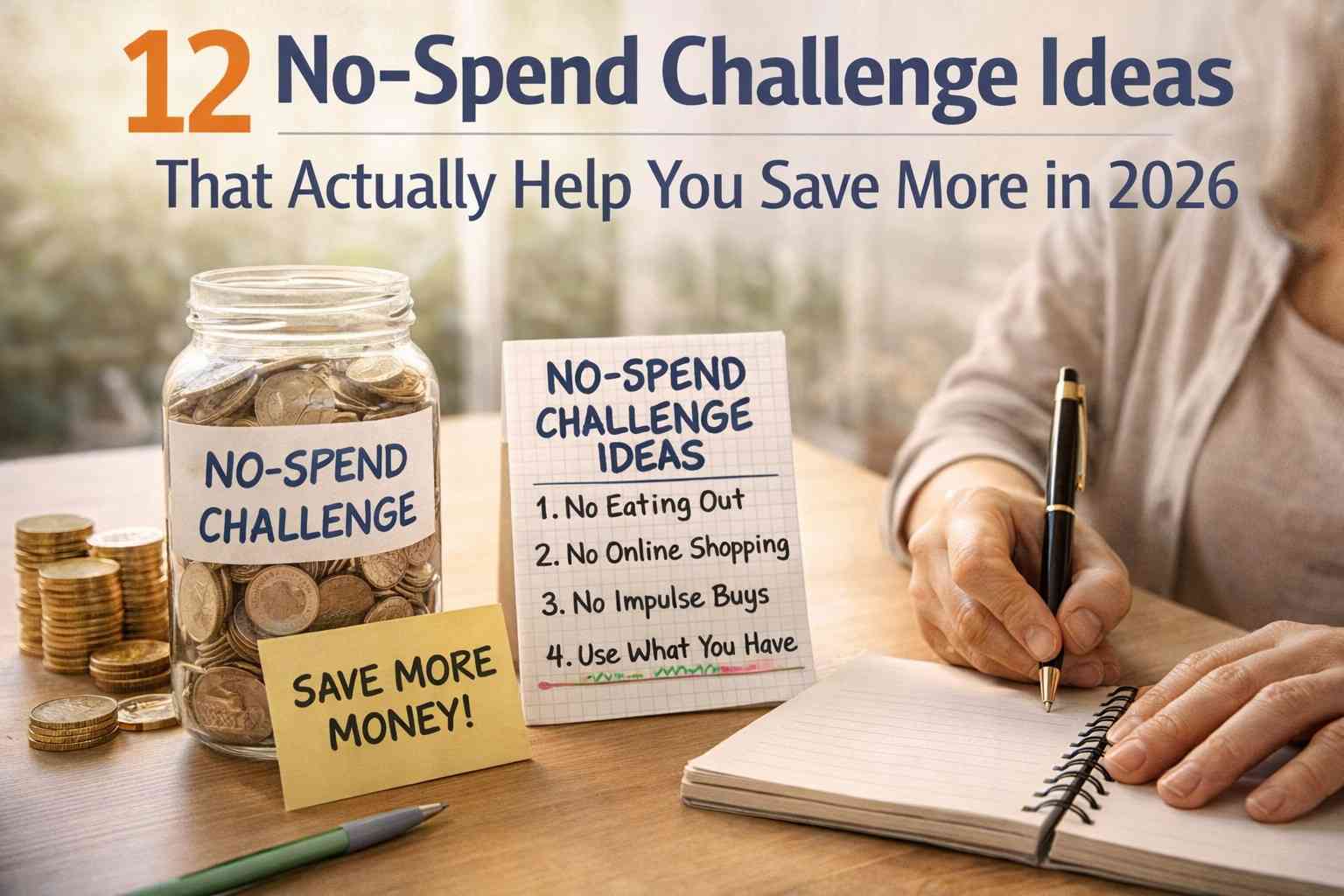
12 No-Spend Challenge Ideas That Actually Help You Save More in 2026
Introduction: No-Spend Challenge Ideas
Most people have tried some version of a spending detox at least once. The idea sounds simple — stop spending on non-essentials for a set period, save the difference, reset your habits. Clean, straightforward, and effective on paper.
In practice, the blanket “spend nothing for 30 days” approach collapses within the first week for most people. It’s too vague, too extreme, and completely disconnected from real daily life. Social obligations exist. Small enjoyments matter. Motivation disappears fast when every day feels like punishment.
The no-spend challenge ideas in this guide work differently. Each one targets a specific spending category, runs for a realistic timeframe, and is designed around behavioral change — not just temporary restriction. These are approaches that genuinely produce results because they match how real people actually live and spend.
Why Targeted No-Spend Challenges Work Better Than General Ones
A broad “spend nothing” rule creates constant negotiation with yourself. Is this essential or not? Does this count? The mental exhaustion of those micro-decisions kills most no-spend challenge ideas before the second week arrives.
Category-specific no-spend challenge ideas eliminate that negotiation entirely. The rule is binary and clear — no food delivery this week, full stop. No online shopping for 14 days, no exceptions. That clarity is what makes the behavioral change actually stick.
The second benefit is data. Running a targeted no-spend challenge in one specific area shows you exactly what that category costs you monthly — often a number that’s larger and more surprising than you expected. That honest number changes how you make spending decisions in that category permanently, not just during the challenge period.
Challenge 1 — The 7-Day No Food Delivery Challenge
Food delivery is where most urban budgets leak the most — and the least noticeably. Individual orders feel modest. The monthly total rarely does.
This no-spend challenge idea runs for exactly seven days. Zero food delivery orders. All meals come from your kitchen, a canteen, or a place you physically travel to. No apps, no exceptions.
At week’s end, calculate what you would have spent based on your typical ordering frequency. Transfer that exact amount to a separate savings account immediately. The physical transfer turns a behavioral win into a concrete financial result.
Most people who finish this no-spend challenge extend it voluntarily into week two — because the cooking habit, once restarted, feels more manageable than they remembered.
Challenge 2 — The 30-Day No Impulse Purchase Challenge
Impulse spending is responsible for a significant portion of most people’s monthly overspend. This no-spend challenge idea doesn’t eliminate purchasing — it adds a mandatory waiting period.
For 30 days, any non-essential purchase above ₹500 requires 72 hours before buying. Add it to a wishlist. Screenshot it. Write it down. But no immediate purchase.
At month end, review the list. Most items will feel unnecessary or even puzzling by then. The ones that still feel genuinely worth buying after 72 hours — buy them. The ones that faded — that’s money saved without any real sacrifice, because the desire wasn’t genuine to begin with.
This no-spend challenge idea consistently reveals how much monthly spending is driven by manufactured desire rather than real need.
Challenge 3 — The Weekend No-Spend Challenge
For beginners uncertain about longer no-spend challenge ideas, a single weekend is the perfect entry point. Low commitment, surprisingly effective, and genuinely eye-opening.
Pick any Friday evening through Sunday night. No discretionary spending for 48 hours. Groceries already at home are fine. Everything else — restaurants, delivery, entertainment purchases, shopping — stops.
Plan the weekend in advance. Cook something enjoyable Friday evening. Use free entertainment — a park, a walk, a film you already own. The practical savings from one weekend are modest. The learning is significant.
Most people discover that a non-spending weekend is more enjoyable than expected. That discovery alone makes this one of the most valuable no-spend challenge ideas for beginners.
Challenge 4 — The 90-Day No New Clothing Challenge
Clothing spending accumulates invisibly. A kurta here, shoes there, a jacket on sale — each purchase feels reasonable individually. The quarterly total usually isn’t.
This no-spend challenge idea is straightforward: for 90 days, buy no new clothing whatsoever. No exceptions for sales, events, or items that wore out. Work with the wardrobe you have.
Before starting, spend an hour going through everything you own. Most people find forgotten items — things with tags still on, pieces that just needed a different combination. The challenge reveals that most wardrobes are more than sufficient for three months.
The financial savings surprise people consistently. Those not tracking clothing spending often discover they were spending ₹2,000 to ₹5,000 monthly — money that simply stays unspent for a full quarter.
Challenge 5 — The Subscription Audit Challenge
This no-spend challenge idea requires one dedicated hour and produces ongoing monthly savings indefinitely after that single effort.
Go through your last two months of bank statements. List every recurring subscription charge — every streaming platform, app subscription, automatic renewal, cloud storage plan, and membership of any kind.
For each one: have you actively used this in the last 30 days? If the answer is no — cancel it today. Not pause — cancel. Then for subscriptions you use but could pause, suspend them for one month. At month end, consciously decide whether to reinstate based on whether you genuinely missed the service.
Most people running this no-spend challenge idea find ₹500 to ₹2,000 in forgotten subscriptions immediately. That money was leaving automatically every month producing zero enjoyment.
Challenge 6 — The No-Restaurant Month
For 30 days, no restaurants, no cafes, no paying for food in any establishment. Grocery shopping continues normally. All meals come from your kitchen.
The savings from this no-spend challenge idea vary significantly by eating-out frequency. For someone dining out three to five times weekly, the monthly savings typically reach ₹3,000 to ₹8,000. Transfer weekly savings to a dedicated account to keep progress visible and motivation high.
A secondary benefit worth mentioning: by day 20, most participants have meaningfully expanded their cooking repertoire simply because variety becomes necessary rather than optional.
For tracking this challenge’s savings as part of a broader monthly goal, this guide on how to save ₹5,000 in 30 days provides a daily tracking structure that works perfectly alongside any single-category no-spend month.
Challenge 7 — The No Online Shopping Challenge for 14 Days
Online shopping has a unique quality that makes it particularly susceptible to impulse purchasing in 2026. The gap between “I want this” and “I bought this” is three taps on an Android phone. No travel, no waiting, no social friction.
This no-spend challenge idea removes that immediacy for two weeks. Move shopping apps off your home screen — not deleted, just relocated to a folder requiring deliberate navigation. No browsing e-commerce platforms. No casual “just looking” sessions.
If something genuinely essential needs ordering, write it down and wait until day 15. In most cases, the urgency disappears completely before the challenge ends.
Most people are surprised by two things: how much passive time they spent browsing shopping apps, and how much that browsing was costing them monthly without conscious awareness.
Challenge 8 — The Cash-Only Weekend Challenge
Digital payments have made spending so frictionless that financial impact barely registers in the moment. This no-spend challenge idea restores physical money psychology for 48 hours.
Withdraw a fixed cash amount on Friday — ₹1,500 or ₹2,000 depending on your normal weekend spending. Use only that cash for all weekend purchases. When it’s gone, weekend discretionary spending is finished.
The physical experience of handing over notes creates a completely different relationship with spending than digital payment. This is documented behavioral economics — people consistently spend less when using physical cash versus digital payments for identical purchases.
Run this no-spend challenge once per month as an ongoing habit rather than a one-time experiment. The regular recalibration prevents digital spending habits from drifting unnoticed.
Challenge 9 — The No Coffee Shop Challenge for 21 Days
For urban professionals in 2026, coffee shops serve a dual purpose — coffee and a comfortable workspace or social meeting point. Both underlying needs can be met without the per-visit cost.
For 21 days, this no-spend challenge idea requires making coffee at home, meeting people in free public spaces, and working from your office or home. Track what you would have spent based on typical weekly visit frequency.
The savings vary from modest to significant depending on visit frequency. The behavioral learning — discovering which coffee shop visits were genuinely enjoyable versus purely habitual — is often more valuable than the money saved.
Challenge 10 — The Buy-Nothing Week Challenge
The most comprehensive short-duration entry among these no-spend challenge ideas — for seven days, buy absolutely nothing beyond food, medication, and pre-committed financial obligations.
No clothing. No discretionary purchases of any kind. No coffee. No delivery. No casual shopping. Every time an urge to buy something appears and gets redirected, you’re gathering honest data about what you spend on habitually versus what you genuinely value.
At week’s end, review every purchase you almost made but didn’t. Which ones do you still want seven days later? That surviving list is a map of your actual spending priorities versus your habitual impulses — and that distinction is what this no-spend challenge idea is genuinely designed to reveal.
Challenge 11 — The No Entertainment Spending Challenge for 30 Days
This no-spend challenge idea specifically targets paid entertainment — cinema tickets, event tickets, paid gaming content, and any entertainment beyond existing subscriptions.
For 30 days, entertainment is free only. YouTube. Library books. Free community events. Long walks. Cooking something ambitious. The goal isn’t eliminating fun — it’s discovering how much enjoyment exists without additional spending.
Most people find free entertainment fills the same psychological need as paid entertainment, with slightly more creativity required in sourcing it. The money not spent on paid entertainment across a month — typically ₹1,500 to ₹4,000 depending on habits — transfers directly to savings.
Challenge 12 — The Full No-Spend Month Challenge
The most ambitious of all no-spend challenge ideas — and the one producing the most significant financial and behavioral results when completed with genuine commitment.
January works naturally following high-spending December. But any month works if the preparation is done properly beforehand.
Setting It Up Correctly
Define rules clearly before day one. Essential spending continues — groceries, bills, transport for work, medication. Everything discretionary stops for 30 days. Write the rules down in your notes app so there’s no ambiguity during the month.
Managing Social Situations
Tell friends and family in advance. Most people are more supportive than expected — and some will join you. Have free alternatives ready for invitations to spend-oriented social events.
What to Expect Week by Week
Week one is the hardest — automatic spending impulses fire constantly and require active redirection. Week two gets measurably easier as new patterns form. Week three, the new baseline starts feeling normal. Week four is genuinely comfortable, and the savings balance visible in your dedicated account provides real motivation to finish.
For building the structure that captures these savings into a lasting monthly budget after the challenge ends, this step-by-step guide on creating a monthly budget plan shows exactly how to translate what you learned during the challenge into permanent monthly spending limits.
Tracking Your Results on Android
Regardless of which no-spend challenge idea you choose, tracking results makes the behavioral change feel real and sustainable beyond the challenge period.
Create a simple note in Google Keep with two figures updated daily — “would have spent” and “actually spent.” Every redirected purchase gets logged. At challenge end, transfer the total difference to a dedicated savings account as a physical act of completing the challenge.
Set a daily 9 PM reminder on your Android phone to update the log. Two minutes per day of tracking is sufficient to maintain full visibility without adding friction.
Making Results Last After the Challenge Ends
The best no-spend challenge ideas aren’t designed to change your life for one week. They’re designed to reveal something true about your spending that changes decisions permanently.
After any challenge, spend 20 minutes reviewing what you actually missed versus what you thought you’d miss. The categories you didn’t genuinely miss — those become permanent savings. The habits that returned because they add real value — keep them, now more consciously and intentionally than before.
For strategies on maintaining the financial momentum a no-spend challenge creates over the following months, this guide on how to stick to a budget every month without feeling restricted covers the behavioral habits that sustain financial progress long after any single challenge is complete.
Final Conclusion: No-Spend Challenge Ideas
No-spend challenge ideas work because they’re specific, time-limited, and honest about targeting the spending categories that drain the most money without adding proportional value to daily life. They’re not about permanent deprivation — they’re about deliberate pauses that reveal what your money is actually doing and whether it’s aligned with what you genuinely value.
Start with the challenge that targets your biggest spending weakness. Run it with genuine commitment for the defined period. Track results concretely. Use what you learn to permanently adjust the patterns the challenge revealed as habitual rather than meaningful.
One well-executed no-spend challenge consistently saves more in 30 days than months of vague intentions to “spend less.” The clear structure is what makes the difference. Pick one challenge from this list, start this week, and discover what your spending habits have been doing without your full attention.


Post Comment